
Recipe Snapshot
Recipe at a Glance
Key timing, yield and style details before you start cooking.
Base Composition and Umami Calibration
The structural flavour of Myeolchi Guk depends on the controlled extraction of glutamates from dried anchovies balanced by the mineral depth of kelp. The anchovy’s protein and fat content release soluble amino acids under sub-boiling conditions, forming a clean umami base without bitterness. Removing the anchovy heads and guts before simmering prevents excessive metallic notes. Salt calibration occurs late in the process to avoid over-concentration during reduction. The addition of radish introduces mild sweetness and starch-derived body, stabilising the broth’s mouthfeel while maintaining clarity. Proper hydration sequencing ensures that the kelp hydrates before heat application, preventing clouding and preserving a translucent finish.
Thermal Management and Extraction Control
Temperature staging is critical: the broth must remain below a rolling boil during the extraction phase to prevent emulsification of anchovy oils, which would cloud the liquid and introduce bitterness. Kelp is removed just before boiling to avoid excessive iodine release. Maintaining a gentle simmer for 10–15 minutes allows full flavour diffusion without structural breakdown of the anchovies. Evaporation is managed by partially covering the Stock Pot, balancing concentration with volume retention. Carryover heat continues mild extraction after the heat source is turned off, so timing removal of solids is essential to prevent over-extraction and maintain a clean, balanced broth.
Transformation and Clarification Dynamics
During simmering, proteins from anchovies denature and coagulate, binding fine particulates that would otherwise cloud the broth. The radish softens, releasing mild sugars that round the salt and umami balance. Once strained, the broth achieves a light amber hue with a clean aroma. The transformation from raw marine intensity to refined savoury clarity is achieved through controlled heat and precise timing. The final broth serves as both a standalone soup and a foundational stock for Korean stews, demonstrating the importance of controlled protein denaturation and particulate management in achieving visual and flavour purity.
Workflow Efficiency and Mise en Place Logic
Anchovy preparation, kelp soaking, and radish slicing should be completed before heat application to streamline workflow. Anchovy cleaning is best done in batches, ensuring uniform extraction quality. While the broth simmers, secondary garnishes such as spring onions or tofu can be prepped for integration. Using a fine Sieve for straining eliminates the need for secondary filtration. Efficient sequencing reduces idle time and ensures consistent broth clarity across multiple batches, a key consideration in professional kitchens where broth forms the base for multiple service components.
Regional Technique and Culinary Lineage
Myeolchi Guk originates from coastal Korean cooking traditions where dried anchovies were a preservation necessity and a primary source of umami. The method evolved alongside kelp-based broths from Jeju and southern provinces, where mineral-rich seawater influenced ingredient selection. The technique reflects a balance between Japanese kombu dashi and Korean stock logic, adapted for domestic anchovy species. Modern kitchens maintain the same extraction discipline but may use filtered water and controlled simmering equipment to replicate the clean, oceanic clarity characteristic of traditional Korean broth foundations.
Recipe Education
Learn the Skills Behind This Recipe
Build confidence with cooking skills, techniques, and tools used in this recipe.
Cooking Basics
Build safer knife preparation, heat control, timing, and everyday kitchen confidence.
Helpful when using chef knife during preparation.
How to Boil Properly
Learn boiling times, temperature control, and how to avoid overcooking.
Recommended for the boil method used in this recipe.
Cookware Guide
Learn which pots and pans work best for frying, sautéing, simmering, and roasting.
Helpful when using saucepan during preparation.
Baking Tools Guide
Understand essential tools for mixing, measuring, and preparing recipes.
Helpful when using mixing bowl during preparation.
Simmer vs Boil
Learn when to simmer, when to boil, and how each affects recipe results.
Recommended for the simmer method used in this recipe.


Anchovy Broth Soup (Myeolchi Guk)
Description
The structural flavour of Myeolchi Guk depends on the controlled extraction of glutamates from dried anchovies balanced by the mineral depth of kelp. The anchovy’s protein and fat content release soluble amino acids under sub-boiling conditions, forming a clean umami base without bitterness. Removing the anchovy heads and guts before simmering prevents excessive metallic notes. Salt calibration occurs late in the process to avoid over-concentration during reduction. The addition of radish introduces mild sweetness and starch-derived body, stabilising the broth’s mouthfeel while maintaining clarity. Proper hydration sequencing ensures that the kelp hydrates before heat application, preventing clouding and preserving a translucent finish.
Ingredients
Ingredients
Instructions
Instructions
Step 1
Rinse the dried anchovies briefly, remove heads and guts, and pat dry. Wipe the dried kelp with a damp cloth to remove surface salt or debris.Removing anchovy innards prevents bitterness during extraction and maintains a clean broth profile.Step 2
Place the kelp and water in a Stock Pot and let it soak for 20 minutes before heating to allow gradual hydration and mineral release.Pre-soaking kelp in cold water maximises glutamate extraction without clouding the broth.Step 3
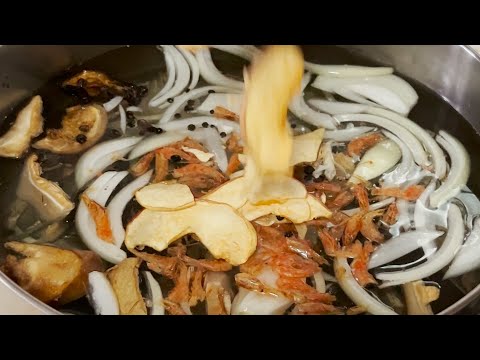
Add the prepared anchovies and sliced radish to the pot. Bring to a gentle simmer over medium heat, then immediately reduce to low heat.Avoid boiling; maintain a steady simmer to prevent emulsifying anchovy oils and clouding the broth.Step 4
Simmer uncovered for 10–15 minutes, skimming any foam that rises. Remove the kelp just before the liquid reaches a full boil.Removing kelp early prevents excessive iodine release and preserves a balanced marine flavour.Step 5
Strain the broth through a fine Sieve into a clean Mixing Bowl. Discard solids. Season the clear broth with soy sauce, salt, and minced garlic if using.Strain while hot to prevent particulate settling, ensuring a consistently clear broth.Step 6
Reheat the seasoned broth gently before serving. Garnish with finely sliced spring onion.Add garnish only at service to maintain colour and prevent chlorophyll leaching into the broth.
Recommended Equipment

Nutrition Facts
Servings 4
Serving Size 1 portion
- Amount Per Serving
- Calories 16.05kcal
- % Daily Value *
- Total Fat 0.3g1%
- Saturated Fat 0.08g1%
- Cholesterol 3mg1%
- Sodium 412.98mg18%
- Potassium 118.94mg4%
- Total Carbohydrate 1.94g1%
- Dietary Fiber 0.7g3%
- Sugars 0.78g
- Protein 1.54g4%
- Vitamin C 6.13 mg
- Calcium 31.25 mg
- Iron 0.43 mg
- Vitamin K 5.26 mcg
- Riboflavin 0.04 mg
- Niacin 0.88 mg
- Vitamin B6 0.05 mg
- Folate 15.58 mcg
- Pantothenic Acid 0.12 mg
- Phosphorus 20.83 mg
- Magnesium 12.41 mg
- Zinc 0.27 mg
- Selenium 2.19 mcg
- Copper 0.08 mg
- Manganese 0.06 mg
* Nutrition information is provided as an estimate per serving and may vary depending on the ingredients, brands, substitutions, portion sizes and preparation methods used. Percent Daily Values (%DV) are based on U.S. FDA reference values for a 2,000-calorie diet and are intended as a general guide only. Individual nutritional needs vary. This information is not a substitute for advice from a registered dietitian or other qualified healthcare professional.
Note
Allow the dish to cool gradually before sealing. Rapid temperature shifts can create condensation, weakening texture and diluting surface flavour concentration. Slow-cooked preparations often improve after several hours or overnight refrigeration as aromatic compounds integrate more fully. Texture refinement often occurs naturally during resting due to internal moisture redistribution.


