
Recipe Snapshot
Recipe at a Glance
Key timing, yield and style details before you start cooking.
Ingredient Structure and Moisture Control
Banana bread’s crumb density and residual moisture dictate how it absorbs custard. A loaf with moderate hydration—achieved through ripe bananas balanced by flour and egg protein—prevents collapse during soaking. The starch matrix must be firm enough to retain shape yet porous enough for even custard penetration. Fat from butter and egg yolk stabilises the crumb, while sugar caramelises under heat to form a crisp exterior. Salt and vanilla enhance aromatic compounds, ensuring the custard complements rather than masks the banana profile. Using day-old slices improves absorption uniformity, as surface dehydration moderates liquid uptake and prevents sogginess.
Heat Application and Surface Browning
Temperature staging is critical to achieve a custard set without over-drying the crumb. Medium heat in a Non-stick Skillet allows Maillard browning without scorching the sugars. Excessive heat causes uneven caramelisation and potential splitting of the egg matrix. Controlled butter foaming indicates correct pan temperature—too cold and the bread steams; too hot and the crust burns before the interior sets. Maintaining consistent heat across batches ensures uniform texture and colour. The goal is a golden-brown crust with a custard interior reaching structural cohesion through gentle coagulation rather than aggressive frying.
Custard Transformation and Texture Development
During cooking, the egg proteins denature and form a delicate network that binds milk fat and absorbed moisture within the bread. This transformation converts the soaked slice into a cohesive custard layer integrated with the banana crumb. The sugar caramelises on contact with the pan, generating a thin crisp shell that contrasts the soft interior. Proper timing ensures the custard sets before the crust overbrowns. Resting briefly post-cook allows steam redistribution, stabilising the crumb and preventing surface collapse. The result is a balanced texture gradient—crisp exterior, tender custard centre, and aromatic banana undertone.
Workflow Efficiency and Batch Coordination
For service efficiency, custard can be pre-mixed and held under refrigeration for up to four hours. Banana bread slices should be portioned uniformly to ensure even soak and cook times. Soaking multiple slices simultaneously in a shallow dish optimises throughput without over-saturation. Using a preheated Non-stick Skillet or Griddle in rotation maintains production flow. Butter should be refreshed between batches to prevent burnt milk solids. Finished slices can hold briefly on a Cooling Rack over a Baking Sheet in a low oven to maintain crispness while assembling plates.
Cultural and Culinary Context
This preparation merges two established Western breakfast structures: quick bread and custard-soaked toast. French toast, originating from medieval European methods of reviving stale bread, adapts seamlessly to banana bread’s dense crumb. The technique reflects North American brunch evolution, where enriched loaves and flavoured batters became standard. The banana component, introduced through 20th-century baking trends, adds tropical sweetness and moisture, aligning with modern comfort-focused breakfast menus. The dish exemplifies adaptive culinary lineage—traditional custard frying applied to a quick bread base, producing a hybrid that balances nostalgia with technical precision.
Recipe Education
Learn the Skills Behind This Recipe
Build confidence with cooking skills, techniques, and tools used in this recipe.
Baking Tools Guide
Understand essential tools for mixing, measuring, and preparing recipes.
Helpful when using mixing bowl during preparation.
How to Fry Properly
Understand pan heat, oil temperature, and how to get better frying results.
Recommended for the fry method used in this recipe.
How to Sauté Properly
Master fast cooking, pan heat, and ingredient timing for better texture.
Recommended for the saute method used in this recipe.
Oven Temperature Conversions
Understand oven temperatures and how they affect baking and roasting.
Helpful when using sheet pan during preparation.


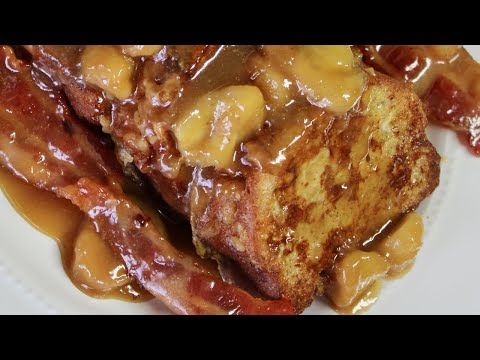
Banana Bread French Toast
Description
Banana bread’s crumb density and residual moisture dictate how it absorbs custard. A loaf with moderate hydration—achieved through ripe bananas balanced by flour and egg protein—prevents collapse during soaking. The starch matrix must be firm enough to retain shape yet porous enough for even custard penetration. Fat from butter and egg yolk stabilises the crumb, while sugar caramelises under heat to form a crisp exterior. Salt and vanilla enhance aromatic compounds, ensuring the custard complements rather than masks the banana profile. Using day-old slices improves absorption uniformity, as surface dehydration moderates liquid uptake and prevents sogginess.
Ingredients
Ingredients
Instructions
Instructions
Step 1
Whisk eggs, whole milk, double cream, caster sugar, vanilla extract, and salt in a Mixing Bowl until fully combined and smooth.Use a Whisk to aerate slightly; this ensures even custard coating without streaks of unblended egg.Step 2
Pour the custard mixture into a shallow dish. Lay banana bread slices in a single layer and soak for 20–30 seconds per side until evenly saturated but not collapsing.Rotate slices gently with Tongs to prevent tearing; over-soaking leads to structural breakdown during frying.Step 3
Heat a Non-stick Skillet over medium heat. Add half the butter and oil, allowing butter to foam but not brown.Combining oil with butter raises the smoke point, maintaining consistent browning without burnt milk solids.Step 4
Place soaked slices into the skillet and cook 2–3 minutes per side until golden brown and custard is set through the centre.Monitor colour development; adjust heat slightly between batches to maintain even caramelisation.Step 5
Transfer cooked slices to a Cooling Rack set over a Baking Sheet. Repeat with remaining butter, oil, and bread slices.Resting on a rack prevents steam condensation, preserving the crisp exterior texture.Step 6
Serve warm with a drizzle of maple syrup or other toppings as desired.Apply syrup immediately before service to avoid softening the crust prematurely.
Recommended Equipment

Nutrition Facts
Servings 4
Serving Size 1 portion
- Amount Per Serving
- Calories 610.02kcal
- % Daily Value *
- Total Fat 30.81g48%
- Saturated Fat 11.74g59%
- Cholesterol 227.62mg76%
- Sodium 449.71mg19%
- Potassium 316.69mg10%
- Total Carbohydrate 73.76g25%
- Dietary Fiber 1.32g6%
- Sugars 6.18g
- Protein 12g24%
- Vitamin A 1249.91 IU
- Vitamin C 2.12 mg
- Calcium 125.41 mg
- Iron 2.36 mg
- Vitamin D 1.63 mcg
- Vitamin E 1.12 mg
- Vitamin K 2.88 mcg
- Thiamin 0.26 mg
- Riboflavin 0.56 mg
- Niacin 1.84 mg
- Vitamin B6 0.28 mg
- Folate 57.95 mcg
- Vitamin B12 0.77 mcg
- Pantothenic Acid 1.12 mg
- Phosphorus 205.09 mg
- Magnesium 29.72 mg
- Zinc 1.19 mg
- Selenium 27.46 mcg
- Copper 0.12 mg
- Manganese 0.38 mg
* Nutrition information is provided as an estimate per serving and may vary depending on the ingredients, brands, substitutions, portion sizes and preparation methods used. Percent Daily Values (%DV) are based on U.S. FDA reference values for a 2,000-calorie diet and are intended as a general guide only. Individual nutritional needs vary. This information is not a substitute for advice from a registered dietitian or other qualified healthcare professional.
Note
Store in an airtight container under refrigeration, ensuring minimal air exposure to preserve flavour integrity and textural balance. The resting phase supports structural stabilisation and moisture redistribution. Cutting or serving too early may compromise internal balance. Dairy-based elements may thicken further upon cooling. Reheat gently to prevent separation or grainy texture. Monitor seasoning levels after storage, as salt perception can shift once chilled.


