
Recipe Snapshot
Recipe at a Glance
Key timing, yield and style details before you start cooking.
Ingredient Hydration and Structural Balance
Mashed ripe bananas provide both moisture and natural sweetness, reducing the need for excess fat while maintaining crumb tenderness. The ratio of wet to dry ingredients must be controlled to prevent a dense texture; overhydration leads to gummy interiors. Chopped nuts introduce fat and texture contrast, but their oil content can interfere with gluten formation if not balanced by sufficient flour. Brown sugar contributes hygroscopic stability, retaining moisture post-bake. The inclusion of eggs stabilises the emulsion between banana puree and melted butter, ensuring even crumb distribution. Baking powder and bicarbonate of soda work synergistically with the banana’s acidity to create lift without overexpansion.
Thermal Control and Baking Dynamics
Oven temperature must remain stable at 180°C to achieve uniform rise and caramelisation. Excessive heat causes premature crust formation, restricting internal expansion. Muffin batter should enter the oven immediately after mixing to preserve leavening gas retention. The brown sugar glaze requires gentle simmering to dissolve crystals fully before application; overheating leads to recrystallisation and grainy texture. Carryover heat from the muffins assists glaze absorption, forming a thin, glossy coating. Even spacing on the Baking Sheet ensures consistent airflow and browning symmetry across all units.
Textural Transformation and Flavour Development
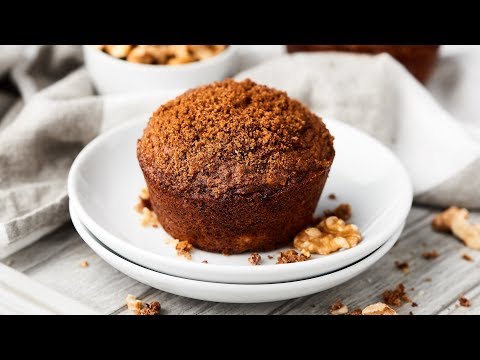
During baking, starch gelatinisation and protein coagulation stabilise the crumb structure. The banana sugars undergo Maillard reactions, deepening flavour and colour. Toasted nuts intensify aromatic complexity through lipid oxidation and browning. The glaze, applied while muffins are warm, forms a semi-set film that enhances sweetness without masking the nutty base. Cooling on a rack prevents condensation from softening the crust. Properly executed, the final product exhibits a moist interior, crisp top, and balanced sweetness with a subtle caramel undertone from the glaze.
Workflow Efficiency and Mixing Discipline
Mise en place is critical: dry and wet components should be pre-measured to minimise dwell time once combined. Overmixing after flour incorporation develops excess gluten, toughening the crumb. Nuts should be folded last to prevent batter deflation. The glaze can be prepared during the baking phase to streamline service timing. Cooling racks should be ready before removal from the oven to avoid residual steam accumulation. Efficient sequencing ensures consistent batch quality and reduces textural variability between trays.
Cultural and Regional Context
Banana-based quick breads and muffins evolved from early 20th-century American baking, coinciding with the availability of chemical leaveners and imported bananas. The addition of nuts reflects Southern and Midwestern influences where pecans and walnuts were common pantry staples. Brown sugar glaze adapts from traditional caramel sauces used in American home baking, providing a controlled sweetness layer. Modern iterations maintain the same structural logic—moist fruit base, nut texture, and caramelised finish—while optimising for consistent batch production and shelf stability.
Recipe Education
Learn the Skills Behind This Recipe
Build confidence with cooking skills, techniques, and tools used in this recipe.
Baking Tools Guide
Understand essential tools for mixing, measuring, and preparing recipes.
Recommended for the bake method used in this recipe.
Oven Temperature Conversions
Understand oven temperatures and how they affect baking and roasting.
Recommended for the bake method used in this recipe.
Cookware Guide
Learn which pots and pans work best for frying, sautéing, simmering, and roasting.
Helpful when using saucepan during preparation.
Cups to Grams
Convert cup measurements more accurately to improve recipe consistency.
Helpful when using measuring cups during preparation.
Batch Cooking
Cook once and prepare multiple meals more efficiently.
Selected for this type of recipe.


Banana Nut Muffins with Brown Sugar Glaze
Description
Mashed ripe bananas provide both moisture and natural sweetness, reducing the need for excess fat while maintaining crumb tenderness. The ratio of wet to dry ingredients must be controlled to prevent a dense texture; overhydration leads to gummy interiors. Chopped nuts introduce fat and texture contrast, but their oil content can interfere with gluten formation if not balanced by sufficient flour. Brown sugar contributes hygroscopic stability, retaining moisture post-bake. The inclusion of eggs stabilises the emulsion between banana puree and melted butter, ensuring even crumb distribution. Baking powder and bicarbonate of soda work synergistically with the banana’s acidity to create lift without overexpansion.
Ingredients
Ingredients
Instructions
Instructions
Step 1
Preheat oven to 180°C. Line a Muffin Pan with paper cases. Combine plain flour, baking powder, bicarbonate of soda, salt, and light brown sugar in a Mixing Bowl using a Whisk to aerate and distribute leavening evenly.Sifting dry ingredients prevents uneven rise and ensures uniform crumb density.Step 2
In a separate Mixing Bowl, whisk mashed bananas, eggs, melted butter, and milk until smooth. Ensure the mixture is homogenous before combining with dry ingredients.Maintain all wet ingredients at room temperature to prevent butter solidification during mixing.Step 3
Fold wet mixture into dry ingredients using a Silicone Spatula until just combined. Incorporate chopped walnuts gently to avoid overmixing.Stop folding as soon as no visible flour remains; overmixing develops gluten and toughens texture.Step 4
Portion batter evenly into the Muffin Pan, filling each cup about three-quarters full. Bake for 18–20 minutes or until golden brown and a skewer inserted into the centre comes out clean.Rotate the pan halfway through baking to ensure even heat exposure and consistent browning.Step 5
While muffins bake, prepare the glaze: in a Saucepan, combine brown sugar, butter, and milk. Heat over medium until sugar dissolves completely, then simmer briefly. Remove from heat and stir in vanilla extract.Avoid boiling the glaze vigorously; excessive heat causes crystallisation and loss of gloss.Step 6
Transfer baked muffins to a Cooling Rack. While still warm, brush tops with the brown sugar glaze using a Pastry Brush. Allow to set for 10 minutes before serving.Applying glaze while warm enhances absorption and creates a uniform sheen without sogginess.
Recommended Equipment

Nutrition Facts
Servings 12
Serving Size 1 portion
- Amount Per Serving
- Calories 269.89kcal
- % Daily Value *
- Total Fat 13.37g21%
- Saturated Fat 5.2g26%
- Cholesterol 45.97mg16%
- Sodium 208.04mg9%
- Potassium 168.09mg5%
- Total Carbohydrate 34.26g12%
- Dietary Fiber 1.63g7%
- Sugars 15.15g
- Protein 4.84g10%
- Vitamin A 272.55 IU
- Vitamin C 1.82 mg
- Calcium 59.28 mg
- Iron 1.52 mg
- Vitamin D 0.34 mcg
- Vitamin E 0.36 mg
- Thiamin 0.2 mg
- Riboflavin 0.18 mg
- Niacin 1.48 mg
- Vitamin B6 0.15 mg
- Folate 54.05 mcg
- Vitamin B12 0.11 mcg
- Pantothenic Acid 0.37 mg
- Phosphorus 87.59 mg
- Magnesium 26.12 mg
- Zinc 0.56 mg
- Selenium 10.28 mcg
- Copper 0.19 mg
- Manganese 0.49 mg
* Nutrition information is provided as an estimate per serving and may vary depending on the ingredients, brands, substitutions, portion sizes and preparation methods used. Percent Daily Values (%DV) are based on U.S. FDA reference values for a 2,000-calorie diet and are intended as a general guide only. Individual nutritional needs vary. This information is not a substitute for advice from a registered dietitian or other qualified healthcare professional.
Note
Allow the dish to cool gradually before sealing. Rapid temperature shifts can create condensation, weakening texture and diluting surface flavour concentration. The resting phase supports structural stabilisation and moisture redistribution. Cutting or serving too early may compromise internal balance. Dairy-based elements may thicken further upon cooling. Reheat gently to prevent separation or grainy texture. In larger batches, maintain even heat distribution and avoid overcrowding during reheating to preserve structural integrity. Slow-cooked preparations often improve after several hours or overnight refrigeration as aromatic compounds integrate more fully. Texture refinement often occurs naturally during resting due to internal moisture redistribution.


