
Recipe Snapshot
Recipe at a Glance
Key timing, yield and style details before you start cooking.
Ingredient Interaction and Structural Balance
Bibim Guksu relies on the interplay between starch gelatinisation in wheat noodles and the emulsification of a gochujang-based dressing. The sauce’s acidity from vinegar and sweetness from sugar balance the capsaicin heat, while sesame oil provides lipid coating that moderates spice perception. Hydration control is critical: noodles must be rinsed thoroughly in cold water to halt carryover cooking and tighten the gluten network, ensuring a firm, elastic bite. The dressing’s viscosity must be thin enough to coat evenly without pooling, achieved by adjusting liquid ratios after tasting. Salt and acid sequencing is deliberate—acid is added last to prevent premature starch tightening.
Temperature and Moisture Management
The dish’s success depends on precise temperature staging. Noodles are boiled rapidly to full gelatinisation, then shocked in ice water to contract surface starch and prevent clumping. Excess moisture must be fully drained to avoid diluting the sauce. The dressing should be mixed cold to preserve the volatile aromatics of sesame oil and garlic. Overheating the sauce or combining it with warm noodles destabilises the emulsion and dulls flavour intensity. Maintaining all components below 10°C before assembly ensures crisp vegetable texture and a clean, refreshing finish. Moisture control extends to garnishes—cucumber and carrot must be dried after slicing to prevent water bleed.
Transformation Through Mixing and Coating
The transformation occurs not through heat but through mechanical integration. When noodles are tossed with the spicy dressing, starch residues on the surface bind with the emulsion, creating a cohesive coating. This process distributes flavour uniformly and enhances mouthfeel. The sesame oil’s fat phase encapsulates capsaicin, moderating perceived heat while extending aromatic persistence. The vegetables contribute structural contrast—crispness against the pliant noodles—while the egg provides protein richness that rounds the palate. Proper mixing time is short; over-tossing can break the noodle strands and release excess starch, leading to a gummy texture.
Workflow Efficiency and Mise en Place Logic
Efficiency in Bibim Guksu preparation depends on parallel tasking. The sauce can be prepared while water heats for noodles, and vegetables can be sliced during boiling. Cooling and draining must be immediate to prevent overcooking. Mise en place should separate wet and dry components to maintain texture integrity. The final assembly should occur only when all elements are chilled and ready for immediate service. In professional kitchens, pre-cooked noodles are portioned and stored under refrigeration, then refreshed briefly in cold water before dressing to maintain elasticity and prevent sticking.
Cultural and Regional Context
Bibim Guksu originates from Korean temple and home cooking traditions where cold noodle dishes provided relief during humid summers. It evolved alongside Bibimbap, sharing the concept of mixing diverse ingredients with a spicy-sweet gochujang base. The dish reflects regional adaptation—southern versions often include more vinegar and sugar for brightness, while northern styles favour restrained seasoning and thinner noodles. Modern adaptations maintain the cold assembly principle but may incorporate additional vegetables or proteins. Its enduring appeal lies in the controlled balance of heat, acidity, and texture achieved through precise cold preparation.
Recipe Education
Learn the Skills Behind This Recipe
Build confidence with cooking skills, techniques, and tools used in this recipe.
How to Boil Properly
Learn boiling times, temperature control, and how to avoid overcooking.
Recommended for the boil method used in this recipe.
Cooking Basics
Build safer knife preparation, heat control, timing, and everyday kitchen confidence.
Helpful when using chef knife during preparation.
Cookware Guide
Learn which pots and pans work best for frying, sautéing, simmering, and roasting.
Helpful when using saucepan during preparation.
Baking Tools Guide
Understand essential tools for mixing, measuring, and preparing recipes.
Helpful when using mixing bowl during preparation.


Bibim Guksu (Cold Spicy Noodles)
Description
Bibim Guksu relies on the interplay between starch gelatinisation in wheat noodles and the emulsification of a gochujang-based dressing. The sauce’s acidity from vinegar and sweetness from sugar balance the capsaicin heat, while sesame oil provides lipid coating that moderates spice perception. Hydration control is critical: noodles must be rinsed thoroughly in cold water to halt carryover cooking and tighten the gluten network, ensuring a firm, elastic bite. The dressing’s viscosity must be thin enough to coat evenly without pooling, achieved by adjusting liquid ratios after tasting. Salt and acid sequencing is deliberate—acid is added last to prevent premature starch tightening.
Ingredients
Ingredients
Instructions
Instructions
Step 1
Bring a Stock Pot of water to a rolling boil, add salt, and cook somyeon noodles for 3–4 minutes until just tender. Drain immediately and rinse under cold running water until fully cooled.Agitate noodles gently in cold water to remove surface starch and prevent clumping.Step 2
Transfer cooled noodles to a Colander / Strainer and shake off excess water. Set aside to drain completely for 2–3 minutes.Residual moisture will dilute the dressing; ensure noodles are fully drained before mixing.Step 3
In a Mixing Bowl, combine gochujang, gochugaru, soy sauce, rice vinegar, sugar, sesame oil, and minced garlic. Whisk until smooth and emulsified.Whisk in sesame oil last to stabilise the emulsion and preserve its aroma.Step 4
Add the drained noodles to the bowl with the sauce. Toss gently using Tongs until evenly coated and the sauce clings uniformly to each strand.Use a folding motion rather than stirring to avoid breaking the noodles and over-releasing starch.Step 5
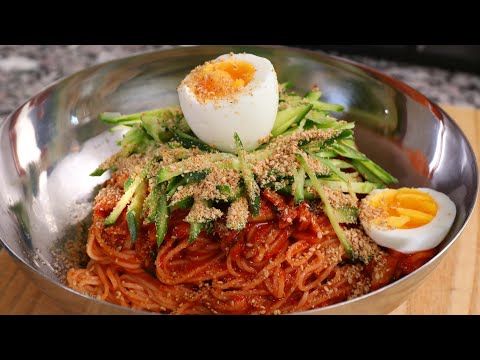
Add julienned cucumber and carrot, mix briefly to distribute. Plate the noodles, top with halved boiled egg, and sprinkle with toasted sesame seeds.Keep vegetables chilled until plating to maintain crisp contrast against the seasoned noodles.
Recommended Equipment

Nutrition Facts
Servings 2
Serving Size 1 portion
- Amount Per Serving
- Calories 545.66kcal
- % Daily Value *
- Total Fat 12.92g20%
- Saturated Fat 2.33g12%
- Cholesterol 81.84mg28%
- Sodium 1329.63mg56%
- Potassium 599.2mg18%
- Total Carbohydrate 89.95g30%
- Dietary Fiber 8.19g33%
- Sugars 10.83g
- Protein 18.93g38%
- Vitamin A 6200.92 IU
- Vitamin C 2.21 mg
- Calcium 96.54 mg
- Iron 4.26 mg
- Vitamin D 0.44 mcg
- Vitamin E 5.13 mg
- Vitamin K 17.61 mcg
- Thiamin 0.16 mg
- Riboflavin 0.31 mg
- Niacin 3.68 mg
- Vitamin B6 0.51 mg
- Folate 40.68 mcg
- Vitamin B12 0.2 mcg
- Pantothenic Acid 1.02 mg
- Phosphorus 299.64 mg
- Magnesium 85.91 mg
- Zinc 2.42 mg
- Selenium 73.15 mcg
- Copper 0.51 mg
- Manganese 1.27 mg
* Nutrition information is provided as an estimate per serving and may vary depending on the ingredients, brands, substitutions, portion sizes and preparation methods used. Percent Daily Values (%DV) are based on U.S. FDA reference values for a 2,000-calorie diet and are intended as a general guide only. Individual nutritional needs vary. This information is not a substitute for advice from a registered dietitian or other qualified healthcare professional.
Note
Store in an airtight container under refrigeration, ensuring minimal air exposure to preserve flavour integrity and textural balance. Adequate chilling or marination enhances aromatic absorption and improves cohesion between fat, acid, and seasoning components. Grains and starches continue absorbing moisture after cooking. Adjust liquid slightly when reheating to restore optimal consistency. Monitor seasoning levels after storage, as salt perception can shift once chilled.


