
Recipe Snapshot
Recipe at a Glance
Key timing, yield and style details before you start cooking.
Hydration and Batter Stability
The pancake batter relies on a controlled hydration ratio between flour, milk, and egg to achieve a balanced viscosity that spreads evenly without over-thinning. The inclusion of melted butter introduces fat that coats flour particles, moderating gluten development and ensuring tenderness. Blueberries add localized moisture; their water release during cooking must be offset by slightly reduced liquid content to prevent sogginess. Sugar contributes mild caramelisation and assists in browning, while baking powder provides lift through carbon dioxide expansion. Salt enhances flavour perception and balances sweetness, preventing the batter from tasting flat. Proper mixing sequence—dry ingredients first, followed by wet incorporation—prevents overactivation of leavening agents before heat application.
Heat Management and Surface Control
Pancake structure depends on consistent medium heat to achieve even browning without premature crusting. A Non-stick Skillet or Cast-Iron Skillet ensures uniform conduction, while a thin butter film prevents sticking and promotes Maillard reaction. Excessive heat causes rapid surface set and undercooked interiors; insufficient heat leads to pale, dense results. The first side must cook until visible bubbles form and edges appear matte, indicating internal steam expansion. Controlled flipping maintains aeration and prevents collapse. Carryover heat continues cooking post-removal, so stacking should occur only after residual steam dissipates to avoid condensation softening the lower layers.
Transformation and Texture Development
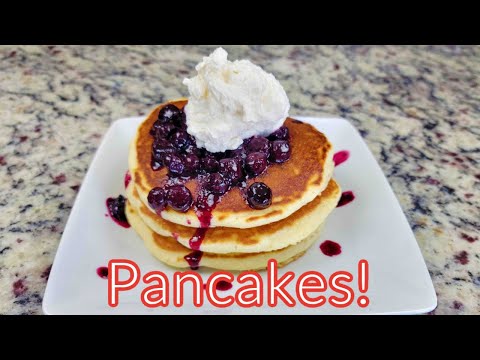
During cooking, starch gelatinisation and protein coagulation occur simultaneously, forming the pancake’s internal matrix. The melted butter emulsifies within the batter, distributing fat evenly and ensuring a moist crumb. Blueberries burst under heat, releasing sugars that caramelise slightly on contact with the pan, creating flavour contrast between sweet fruit pockets and lightly crisped edges. The whipped cream topping introduces a cold, aerated fat element that contrasts the warm, soft pancakes. Proper whipping of cream to soft peaks ensures structural hold without graininess. Over-whipping destabilises the emulsion, leading to separation and loss of smooth texture.
Workflow Efficiency and Parallel Preparation
Efficiency improves when batter rests briefly while the skillet preheats, allowing flour hydration and leavening equilibrium. Whipped cream can be prepared concurrently and refrigerated until assembly. Blueberries should be rinsed and dried in advance to avoid water dilution in the batter. Maintaining a consistent ladle volume ensures uniform pancake diameter for stable stacking. Using a Cooling Rack between batches prevents steam entrapment and maintains surface crispness. Mise en place discipline—pre-measured dry mix, melted butter ready, and utensils staged—reduces downtime between batches and ensures consistent output under time pressure.
Cultural and Regional Context
Pancakes in this form derive from North American breakfast traditions, where chemical leavening replaced yeast-based batters for speed and lightness. The blueberry variant became prominent in regions with seasonal berry abundance, particularly the northeastern United States and Canada. The whipped cream addition reflects modern brunch adaptations, integrating dairy richness for visual and textural contrast. While similar griddle cakes exist globally, the North American stack emphasizes height, uniform layering, and controlled sweetness rather than fermentation depth. This version maintains that lineage while applying professional consistency in portioning and heat control.
Recipe Education
Learn the Skills Behind This Recipe
Build confidence with cooking skills, techniques, and tools used in this recipe.
How to Fry Properly
Understand pan heat, oil temperature, and how to get better frying results.
Recommended for the fry method used in this recipe.
Cups to Grams
Convert cup measurements more accurately to improve recipe consistency.
Helpful when using measuring cups during preparation.
Teaspoons to Grams
Use small-measure conversions more accurately in cooking and baking.
Helpful when using measuring spoons during preparation.
Baking Tools Guide
Understand essential tools for mixing, measuring, and preparing recipes.
Helpful when using mixing bowl during preparation.


Blueberry Pancake Stack with Whipped Cream
Description
The pancake batter relies on a controlled hydration ratio between flour, milk, and egg to achieve a balanced viscosity that spreads evenly without over-thinning. The inclusion of melted butter introduces fat that coats flour particles, moderating gluten development and ensuring tenderness. Blueberries add localized moisture; their water release during cooking must be offset by slightly reduced liquid content to prevent sogginess. Sugar contributes mild caramelisation and assists in browning, while baking powder provides lift through carbon dioxide expansion. Salt enhances flavour perception and balances sweetness, preventing the batter from tasting flat. Proper mixing sequence—dry ingredients first, followed by wet incorporation—prevents overactivation of leavening agents before heat application.
Ingredients
Ingredients
Instructions
Instructions
Step 1
Combine flour, baking powder, caster sugar, and salt in a Mixing Bowl using a Whisk until evenly distributed.Aerate dry ingredients thoroughly to ensure even leavening and prevent dense spots in the final pancakes.Step 2
In a separate Mixing Bowl, whisk milk, egg, and melted butter until homogeneous. Pour wet mixture into dry ingredients and whisk gently until just combined; small lumps are acceptable.Avoid overmixing to prevent excessive gluten formation, which would toughen the pancake crumb.Step 3
Fold in blueberries gently with a Silicone Spatula to distribute evenly without crushing the fruit.Use a folding motion rather than stirring to maintain batter aeration and prevent blueberry bleeding.Step 4
Preheat a Non-stick Skillet over medium heat. Lightly grease with butter. Ladle approximately 60 ml of batter per pancake. Cook until bubbles form on the surface and edges appear set, about 2 minutes. Flip and cook the second side for 1–2 minutes until golden.Maintain consistent heat; adjust between batches to prevent over-browning as the pan retains residual heat.Step 5
Transfer cooked pancakes to a Cooling Rack in a single layer. Repeat with remaining batter, regreasing the skillet as needed.Cooling briefly on a rack prevents steam condensation that softens the pancake surfaces.Step 6
Whip heavy cream, icing sugar, and vanilla extract in a Mixing Bowl using a Hand Mixer until soft peaks form. Refrigerate until assembly.Chill both bowl and beaters before whipping to stabilise the cream and achieve better volume.Step 7
Stack pancakes on a plate, layering 3–4 per portion. Top with a generous spoonful of whipped cream and a few fresh blueberries for garnish.Assemble immediately before serving to maintain temperature contrast between warm pancakes and cold cream.
Recommended Equipment

Nutrition Facts
Servings 4
Serving Size 1 portion
- Amount Per Serving
- Calories 532.63kcal
- % Daily Value *
- Total Fat 32.02g50%
- Saturated Fat 19.62g99%
- Cholesterol 132.37mg45%
- Sodium 515.38mg22%
- Potassium 247.24mg8%
- Total Carbohydrate 57.69g20%
- Dietary Fiber 2.25g9%
- Sugars 11.07g
- Protein 10.48g21%
- Vitamin A 1235.83 IU
- Vitamin C 3.94 mg
- Calcium 278.56 mg
- Iron 2.95 mg
- Vitamin D 1.92 mcg
- Vitamin E 1.13 mg
- Vitamin K 10.1 mcg
- Thiamin 0.46 mg
- Riboflavin 0.5 mg
- Niacin 3.23 mg
- Vitamin B6 0.12 mg
- Folate 101.31 mcg
- Vitamin B12 0.55 mcg
- Pantothenic Acid 0.82 mg
- Phosphorus 232.4 mg
- Magnesium 26.89 mg
- Zinc 0.95 mg
- Selenium 23.24 mcg
- Copper 0.11 mg
- Manganese 0.48 mg
* Nutrition information is provided as an estimate per serving and may vary depending on the ingredients, brands, substitutions, portion sizes and preparation methods used. Percent Daily Values (%DV) are based on U.S. FDA reference values for a 2,000-calorie diet and are intended as a general guide only. Individual nutritional needs vary. This information is not a substitute for advice from a registered dietitian or other qualified healthcare professional.
Note
Store in an airtight container under refrigeration, ensuring minimal air exposure to preserve flavour integrity and textural balance. The resting phase supports structural stabilisation and moisture redistribution. Cutting or serving too early may compromise internal balance. Dairy-based elements may thicken further upon cooling. Reheat gently to prevent separation or grainy texture. Monitor seasoning levels after storage, as salt perception can shift once chilled.


