
Recipe Snapshot
Recipe at a Glance
Key timing, yield and style details before you start cooking.
Starch and Fat Interaction in Layered Potato Systems
The structural integrity of scalloped potatoes depends on controlled starch release from thinly sliced tubers. As the potatoes heat, amylose leaches into the cream base, thickening it naturally without added flour. The fat from butter and cheese emulsifies with the dairy proteins, producing a cohesive sauce that binds the layers. Salt must be applied evenly between layers to penetrate the starch matrix before moisture loss begins. Excess moisture or insufficient fat balance leads to separation or a watery base, while correct hydration ensures a creamy, stable texture that sets properly during resting.
Thermal Management and Browning Control
Temperature staging is critical. The initial covered bake allows even gelatinisation of starches and softening of potato slices without premature surface browning. Once the internal temperature stabilises and the sauce thickens, uncovering the dish promotes Maillard reactions on the cheese and cream surface. Overexposure to high heat before full tenderisation risks uneven texture and burnt edges. Maintaining oven temperature around 180°C ensures gradual moisture evaporation and controlled caramelisation, yielding a golden crust with a uniformly tender interior.
Texture Development and Sauce Stabilisation
During baking, the cream base transitions from fluid to viscous as starch granules swell and proteins denature. The cheese melts, dispersing evenly through the sauce, while butter reinforces richness and mouthfeel. Proper resting after baking allows the sauce to reabsorb into the potato layers, preventing run-off when portioned. The final texture should be cohesive yet sliceable, with distinct layers visible but bound by a smooth, glossy matrix. Overmixing or disturbing the layers before setting compromises structural definition and sauce stability.
Workflow Efficiency and Layer Assembly Logic
Efficient mise en place reduces oxidation and uneven cooking. Potatoes should be sliced immediately before assembly using a Mandoline for uniform thickness, typically 2–3 mm. Preheating the dairy mixture ensures faster heat transfer once in the oven, shortening total bake time. Layering should alternate potatoes, seasoning, cheese, and sauce to maintain consistent flavour distribution. Avoid overloading the top layer with cheese early in the bake; reserve a portion for final browning to prevent oil separation and uneven crust formation.
Regional Technique Evolution and Adaptation
Scalloped potatoes derive from French gratin dauphinois, traditionally prepared with cream and garlic but without cheese. The modern cheesy variant evolved in North American kitchens, integrating cheddar or similar melting cheeses for richer flavour and visual appeal. The technique retains the French layering and slow-bake method but adapts to regional dairy preferences and oven technology. The dish exemplifies how classical gratin methodology was modified for broader accessibility while maintaining its foundational starch-thickened cream structure.
Recipe Education
Learn the Skills Behind This Recipe
Build confidence with cooking skills, techniques, and tools used in this recipe.
Oven Temperature Conversions
Understand oven temperatures and how they affect baking and roasting.
Recommended for the bake method used in this recipe.
Simmer vs Boil
Learn when to simmer, when to boil, and how each affects recipe results.
Recommended for the simmer method used in this recipe.
Cookware Guide
Learn which pots and pans work best for frying, sautéing, simmering, and roasting.
Helpful when using saucepan during preparation.
Baking Tools Guide
Understand essential tools for mixing, measuring, and preparing recipes.
Recommended for the bake method used in this recipe.
Cups to Grams
Convert cup measurements more accurately to improve recipe consistency.
Helpful when using measuring cups during preparation.
Batch Cooking
Cook once and prepare multiple meals more efficiently.
Selected for this type of recipe.


Cheesy Scalloped Potatoes
Description
The structural integrity of scalloped potatoes depends on controlled starch release from thinly sliced tubers. As the potatoes heat, amylose leaches into the cream base, thickening it naturally without added flour. The fat from butter and cheese emulsifies with the dairy proteins, producing a cohesive sauce that binds the layers. Salt must be applied evenly between layers to penetrate the starch matrix before moisture loss begins. Excess moisture or insufficient fat balance leads to separation or a watery base, while correct hydration ensures a creamy, stable texture that sets properly during resting.
Ingredients
Ingredients
Instructions
Instructions
Step 1
Preheat oven to 180°C. Grease a Casserole Dish with a small amount of melted butter to prevent sticking.Ensure the dish is at room temperature before adding hot liquid to avoid thermal shock and cracking.Step 2
In a Saucepan over medium heat, melt the remaining butter. Add minced garlic and cook for 30 seconds until aromatic. Stir in cream, milk, salt, pepper, and nutmeg. Heat until just below simmering, then remove from heat.Do not boil the cream mixture; overheating can cause fat separation and grainy texture.Step 3
Using a Mandoline, slice potatoes evenly. Layer one-third of the slices in the prepared dish, slightly overlapping. Pour over one-third of the warm cream mixture and sprinkle with one-third of both cheeses.Uniform slice thickness ensures consistent cooking and prevents undercooked layers.Step 4
Repeat layering twice more, finishing with cheese on top. Cover the dish tightly with Tin Foil and bake for 45 minutes until potatoes are tender when pierced with a Paring Knife.Covering traps steam, allowing internal layers to soften before surface browning begins.Step 5
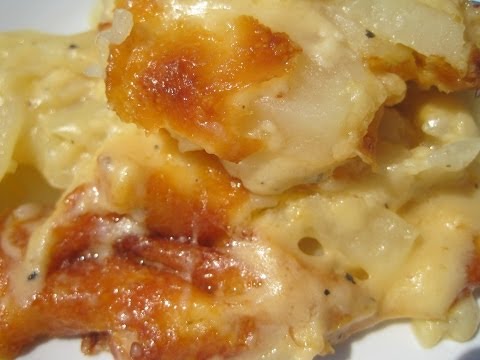
Remove foil and continue baking uncovered for 20–25 minutes until the top is golden brown and bubbling. Allow to rest for 15 minutes before slicing and serving.Resting stabilises the sauce and allows starches to reabsorb liquid, improving slice definition.
Recommended Equipment

Nutrition Facts
Servings 6
Serving Size 1 portion
- Amount Per Serving
- Calories 616.35kcal
- % Daily Value *
- Total Fat 44.15g68%
- Saturated Fat 27.18g136%
- Cholesterol 132.21mg45%
- Sodium 779.94mg33%
- Potassium 985.95mg29%
- Total Carbohydrate 39.61g14%
- Dietary Fiber 4.48g18%
- Sugars 4.98g
- Protein 17.68g36%
- Vitamin A 1598.4 IU
- Vitamin C 40.11 mg
- Calcium 438.87 mg
- Iron 1.79 mg
- Vitamin D 1.7 mcg
- Vitamin E 1.08 mg
- Vitamin K 7.72 mcg
- Thiamin 0.2 mg
- Riboflavin 0.4 mg
- Niacin 2.23 mg
- Vitamin B6 0.67 mg
- Folate 42.59 mcg
- Vitamin B12 0.71 mcg
- Pantothenic Acid 1.05 mg
- Phosphorus 393.03 mg
- Magnesium 67.3 mg
- Zinc 2.31 mg
- Selenium 14.63 mcg
- Copper 0.24 mg
- Manganese 0.35 mg
* Nutrition information is provided as an estimate per serving and may vary depending on the ingredients, brands, substitutions, portion sizes and preparation methods used. Percent Daily Values (%DV) are based on U.S. FDA reference values for a 2,000-calorie diet and are intended as a general guide only. Individual nutritional needs vary. This information is not a substitute for advice from a registered dietitian or other qualified healthcare professional.
Note
Allow the dish to cool gradually before sealing. Rapid temperature shifts can create condensation, weakening texture and diluting surface flavour concentration. The resting phase supports structural stabilisation and moisture redistribution. Cutting or serving too early may compromise internal balance. Dairy-based elements may thicken further upon cooling. Reheat gently to prevent separation or grainy texture. In larger batches, maintain even heat distribution and avoid overcrowding during reheating to preserve structural integrity. Slow-cooked preparations often improve after several hours or overnight refrigeration as aromatic compounds integrate more fully. Texture refinement often occurs naturally during resting due to internal moisture redistribution.


