
Recipe Snapshot
Recipe at a Glance
Key timing, yield and style details before you start cooking.
Fat Distribution and Dough Structure
The crust’s flakiness depends on controlled fat dispersion within the flour matrix. Cold butter must remain in discrete pieces to create steam pockets during baking, generating lift and layered texture. Overmixing develops gluten excessively, resulting in toughness. Hydration must be minimal yet sufficient to bind the dough; excess water promotes gluten formation and inhibits lamination. Salt enhances dough elasticity and balances the filling’s richness. The ratio of butter to flour (approximately 1:2 by weight) ensures a tender but stable structure capable of supporting a moist filling without collapse. Resting the dough before rolling allows gluten relaxation and temperature equalisation for uniform rolling behaviour.
Heat Management and Moisture Control
The filling requires staged heat application to prevent protein tightening and sauce separation. Chicken is seared briefly to develop surface flavour through Maillard reactions, then finished in a controlled simmer to maintain juiciness. Vegetables are sautéed to remove surface moisture before liquid addition, preventing a watery filling. The sauce thickens through flour gelatinisation at approximately 90°C, stabilising the mixture for enclosure. Oven baking at 200°C ensures rapid crust lift before butter fully melts, locking in structure. Carryover heat completes internal thickening without overbrowning the crust. Venting the top crust allows steam release, preventing sogginess.
Textural Transformation During Baking
During baking, the crust transitions from pliable dough to a crisp, laminated shell as butter releases steam and starches gelatinise. The filling’s starch-thickened sauce stabilises under heat, binding the chicken and vegetables into a cohesive matrix. Protein denaturation in chicken and milk solids in the sauce contribute to a creamy, set interior. The contrast between the crust’s dry, flaky exterior and the moist, savoury filling defines the dish’s sensory balance. Proper cooling before cutting allows the gelatinised starches to firm, preventing liquid seepage and maintaining clean slice integrity.
Workflow Coordination and Efficiency
Efficient execution requires parallel processing: dough preparation and chilling can occur while the filling cooks and cools. This sequencing minimises idle time and ensures both components reach assembly readiness simultaneously. Mise en place discipline—pre-chopped vegetables, pre-measured roux base, and preheated oven—prevents temperature drift and overcooking. Rolling the dough between parchment sheets reduces bench flour contamination, preserving hydration balance. For service environments, crusts can be blind-baked partially to maintain crispness under holding conditions. Cooling the filling before assembly prevents premature butter melting in the dough.
Cultural and Regional Context
Chicken pot pie evolved from British meat pies, adapted in North America with cream-based fillings and double crusts. The technique reflects European pastry traditions merged with American comfort food sensibilities. Early versions used leftover roast poultry and root vegetables encased in suet or lard pastry. Modern adaptations favour butter for cleaner flavour and improved lamination. The dish exemplifies practical resource use and textural contrast central to Anglo-American savoury pastry cooking. Its persistence in regional menus underscores its structural reliability and adaptability across service formats from home kitchens to professional operations.
Recipe Education
Learn the Skills Behind This Recipe
Build confidence with cooking skills, techniques, and tools used in this recipe.
Baking Tools Guide
Understand essential tools for mixing, measuring, and preparing recipes.
Recommended for the bake method used in this recipe.
Oven Temperature Conversions
Understand oven temperatures and how they affect baking and roasting.
Recommended for the bake method used in this recipe.
How to Sauté Properly
Master fast cooking, pan heat, and ingredient timing for better texture.
Recommended for the saute method used in this recipe.
Simmer vs Boil
Learn when to simmer, when to boil, and how each affects recipe results.
Recommended for the simmer method used in this recipe.
Cookware Guide
Learn which pots and pans work best for frying, sautéing, simmering, and roasting.
Helpful when using frying pan during preparation.
Batch Cooking
Cook once and prepare multiple meals more efficiently.
Selected for this type of recipe.


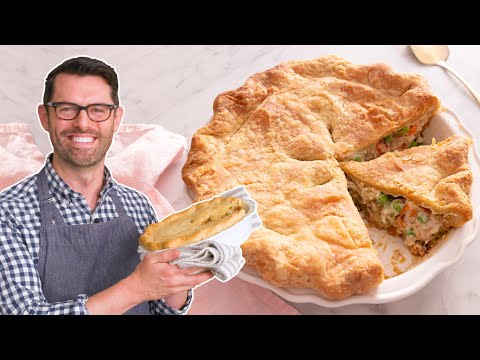
Chicken Pot Pie with Buttery Crust
Description
The crust’s flakiness depends on controlled fat dispersion within the flour matrix. Cold butter must remain in discrete pieces to create steam pockets during baking, generating lift and layered texture. Overmixing develops gluten excessively, resulting in toughness. Hydration must be minimal yet sufficient to bind the dough; excess water promotes gluten formation and inhibits lamination. Salt enhances dough elasticity and balances the filling’s richness. The ratio of butter to flour (approximately 1:2 by weight) ensures a tender but stable structure capable of supporting a moist filling without collapse. Resting the dough before rolling allows gluten relaxation and temperature equalisation for uniform rolling behaviour.
Ingredients
Ingredients
Instructions
Instructions
Step 1
Combine flour and salt in Mixing Bowls. Cut in cold butter using a Pastry Cutter until coarse crumbs form. Add cold water gradually, mixing just until dough binds. Form into a disc, wrap in Cling Film, and chill for 30 minutes.Maintain butter pieces visible in the dough; they create steam pockets for flakiness.Step 2
Heat vegetable oil in a Saute Pan over medium-high heat. Sear chicken cubes until lightly browned but not fully cooked. Remove and reserve.Avoid crowding the pan; excess moisture prevents browning and causes steaming.Step 3
In the same pan, add butter, then sauté onion, carrot, and celery until softened. Stir in flour to form a roux and cook for 2 minutes to remove raw flavour.Keep roux moving with a Wooden Spoon to prevent scorching and ensure even thickening.Step 4
Gradually whisk in warm chicken stock and milk, stirring until smooth. Simmer until thickened. Return chicken to the pan, season with salt and pepper, and cook for 5 minutes. Cool filling to room temperature.Cooling the filling prevents steam from softening the crust during assembly.Step 5
Roll out chilled dough on a lightly floured Pastry Mat to 3 mm thickness. Line a Pie Dish with half the dough, fill with cooled mixture, and cover with remaining dough. Seal edges and cut vents on top.Keep dough cold during rolling; warm dough loses lamination and shrinks in baking.Step 6
Brush top crust with beaten egg. Bake on a Baking Sheet in a preheated oven at 200°C for 35–40 minutes until golden brown and filling bubbles through vents. Rest 10 minutes before slicing.Place the pie on a lower rack to ensure the base crust cooks through without sogginess.
Recommended Equipment

Nutrition Facts
Servings 4
Serving Size 1 portion
- Amount Per Serving
- Calories 859.72kcal
- % Daily Value *
- Total Fat 52.05g81%
- Saturated Fat 27.47g138%
- Cholesterol 213.97mg72%
- Sodium 1071.84mg45%
- Potassium 780.71mg23%
- Total Carbohydrate 63.35g22%
- Dietary Fiber 3.44g14%
- Sugars 5.63g
- Protein 34.1g69%
- Vitamin A 5612.16 IU
- Vitamin C 4.93 mg
- Calcium 108.01 mg
- Iron 4.22 mg
- Vitamin D 1.46 mcg
- Vitamin E 2.29 mg
- Vitamin K 27.21 mcg
- Thiamin 0.7 mg
- Riboflavin 0.66 mg
- Niacin 16.18 mg
- Vitamin B6 0.95 mg
- Folate 158.38 mcg
- Vitamin B12 0.59 mcg
- Pantothenic Acid 2.25 mg
- Phosphorus 398.92 mg
- Magnesium 60.01 mg
- Zinc 1.65 mg
- Selenium 62.23 mcg
- Copper 0.22 mg
- Manganese 0.68 mg
* Nutrition information is provided as an estimate per serving and may vary depending on the ingredients, brands, substitutions, portion sizes and preparation methods used. Percent Daily Values (%DV) are based on U.S. FDA reference values for a 2,000-calorie diet and are intended as a general guide only. Individual nutritional needs vary. This information is not a substitute for advice from a registered dietitian or other qualified healthcare professional.
Note
Allow the dish to cool gradually before sealing. Rapid temperature shifts can create condensation, weakening texture and diluting surface flavour concentration. The resting phase supports structural stabilisation and moisture redistribution. Cutting or serving too early may compromise internal balance. Dairy-based elements may thicken further upon cooling. Reheat gently to prevent separation or grainy texture. Slow-cooked preparations often improve after several hours or overnight refrigeration as aromatic compounds integrate more fully. When reheating crisp components, use dry heat rather than microwave methods to maintain exterior texture. Texture refinement often occurs naturally during resting due to internal moisture redistribution.


