
Recipe Snapshot
Recipe at a Glance
Key timing, yield and style details before you start cooking.
Protein Structure and Binding Control
Crab meat contains delicate muscle fibers with low connective tissue, requiring minimal mechanical agitation to preserve flake integrity. The binding matrix relies on egg and a small proportion of breadcrumbs to stabilize moisture without masking the crab’s natural sweetness. Mayonnaise contributes emulsified fat that enhances cohesion and mouthfeel, while Dijon mustard introduces mild acidity to balance richness. Salt and lemon juice regulate osmotic moisture retention, preventing the mixture from tightening excessively during cooking. The ratio of binder to crab must remain low to maintain a light, seafood-forward texture rather than a dense patty structure.
Heat Application and Moisture Retention
Pan-frying crab cakes demands precise temperature staging. Medium heat ensures sufficient Maillard browning without overcooking the interior. Excessive heat causes surface scorching before the internal proteins set, while low heat promotes oil absorption and sogginess. Pre-chilling the formed cakes firms the fat phase, improving handling and reducing structural collapse during searing. The aioli’s emulsification stability depends on controlled whisking speed and gradual oil incorporation to prevent splitting. Both components benefit from resting before service to allow residual heat equalization and flavor integration.
Textural and Flavor Transformation
During frying, the exterior starches and proteins undergo browning reactions, generating a crisp shell that contrasts the tender interior. The aioli’s garlic infusion mellows through oxidation and fat dispersion, producing a rounded aromatic profile. Lemon juice in the aioli sharpens flavor perception, cutting through the crab’s natural sweetness and fried fat. The final balance depends on maintaining a thin crust with minimal oil retention, ensuring the dish remains light. Proper draining on a Cooling Rack prevents steam entrapment that would soften the crust prematurely.
Workflow Efficiency and Component Coordination
Efficient execution requires parallel preparation: the aioli can be made and refrigerated while the crab mixture chills. Mise en place should prioritize pre-measured aromatics and binders to minimize dwell time once the crab is added. Forming uniform patties ensures even browning and predictable cook times. Using a non-stick surface reduces sticking risk and simplifies flipping. The workflow benefits from sequencing the aioli first, allowing its flavors to mature while the crab cakes rest before frying.
Regional Technique Lineage
Crab cakes originate from the Mid-Atlantic United States, particularly Maryland, where blue crab abundance shaped regional seafood traditions. The preparation evolved from simple pan-seared crab mixtures bound with minimal filler to highlight local shellfish quality. Garlic aioli, rooted in Mediterranean emulsification techniques, integrates seamlessly as a modern accompaniment, replacing traditional tartar sauces with a more refined fat-acid balance. This combination reflects cross-regional adaptation—American coastal seafood paired with European sauce methodology—demonstrating how professional kitchens merge classical emulsions with regional seafood handling.
Recipe Education
Learn the Skills Behind This Recipe
Build confidence with cooking skills, techniques, and tools used in this recipe.
How to Fry Properly
Understand pan heat, oil temperature, and how to get better frying results.
Recommended for the fry method used in this recipe.
Teaspoons to Grams
Use small-measure conversions more accurately in cooking and baking.
Helpful when using measuring spoons during preparation.
Baking Tools Guide
Understand essential tools for mixing, measuring, and preparing recipes.
Helpful when using sheet pan during preparation.
Oven Temperature Conversions
Understand oven temperatures and how they affect baking and roasting.
Helpful when using sheet pan during preparation.


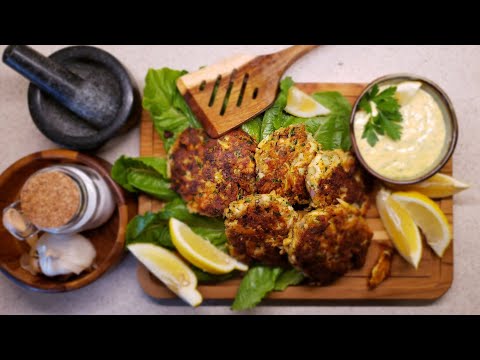
Crab Cakes with Garlic Aioli
Description
Crab meat contains delicate muscle fibers with low connective tissue, requiring minimal mechanical agitation to preserve flake integrity. The binding matrix relies on egg and a small proportion of breadcrumbs to stabilize moisture without masking the crab’s natural sweetness. Mayonnaise contributes emulsified fat that enhances cohesion and mouthfeel, while Dijon mustard introduces mild acidity to balance richness. Salt and lemon juice regulate osmotic moisture retention, preventing the mixture from tightening excessively during cooking. The ratio of binder to crab must remain low to maintain a light, seafood-forward texture rather than a dense patty structure.
Ingredients
Ingredients
Instructions
Instructions
Step 1
In a Mixing Bowl, combine crab meat, breadcrumbs, egg, mayonnaise, Dijon mustard, lemon juice, parsley, salt, and black pepper. Mix gently until just combined without breaking the crab flakes.Fold the mixture with a Silicone Spatula rather than stirring to preserve crab texture and prevent compaction.Step 2
Form the mixture into uniform patties approximately 2 cm thick. Place on a Baking Sheet lined with Parchment Paper and refrigerate for 20 minutes to firm the structure.Chilling stabilizes the fat and binder matrix, reducing the risk of disintegration during frying.Step 3
While the crab cakes chill, prepare the garlic aioli. In a Mixing Bowl, whisk egg yolk, minced garlic, and lemon juice. Slowly drizzle in neutral oil while whisking continuously until a stable emulsion forms. Season with salt.Maintain a consistent whisking speed and add oil gradually to prevent the emulsion from splitting.Step 4
Heat olive oil in a Non-stick Skillet over medium heat. Add crab cakes and pan-fry for 3–4 minutes per side until golden brown and heated through.Avoid overcrowding the pan to maintain surface temperature and ensure even browning.Step 5
Transfer cooked crab cakes to a Cooling Rack to drain excess oil. Rest for 3 minutes before serving with garlic aioli.Resting allows residual steam to escape, preserving the crisp exterior and preventing sogginess.
Recommended Equipment

Nutrition Facts
Servings 4
Serving Size 1 portion
- Amount Per Serving
- Calories 463.96kcal
- % Daily Value *
- Total Fat 36.03g56%
- Saturated Fat 4.08g21%
- Cholesterol 134.41mg45%
- Sodium 1031.61mg43%
- Potassium 270.52mg8%
- Total Carbohydrate 11.81g4%
- Dietary Fiber 0.8g4%
- Sugars 1.19g
- Protein 22.61g46%
- Vitamin A 234.19 IU
- Vitamin C 10.44 mg
- Calcium 89.87 mg
- Iron 1.76 mg
- Vitamin D 0.48 mcg
- Vitamin E 5.14 mg
- Vitamin K 46.94 mcg
- Thiamin 0.21 mg
- Riboflavin 0.18 mg
- Niacin 2.13 mg
- Vitamin B6 0.22 mg
- Folate 74.69 mcg
- Vitamin B12 9.25 mcg
- Pantothenic Acid 0.77 mg
- Phosphorus 288.02 mg
- Magnesium 58.67 mg
- Zinc 6.45 mg
- Selenium 46.77 mcg
- Copper 0.98 mg
- Manganese 0.2 mg
* Nutrition information is provided as an estimate per serving and may vary depending on the ingredients, brands, substitutions, portion sizes and preparation methods used. Percent Daily Values (%DV) are based on U.S. FDA reference values for a 2,000-calorie diet and are intended as a general guide only. Individual nutritional needs vary. This information is not a substitute for advice from a registered dietitian or other qualified healthcare professional.
Note
For best structural retention, cool uncovered briefly before storage to prevent trapped steam from softening exterior crust or caramelised surfaces. The resting phase supports structural stabilisation and moisture redistribution. Cutting or serving too early may compromise internal balance. Spice intensity can deepen over time as volatile compounds settle. Taste and adjust seasoning after resting. When reheating crisp components, use dry heat rather than microwave methods to maintain exterior texture. Acid balance may soften slightly over time; a final adjustment before serving restores clarity.


