
Recipe Snapshot
Recipe at a Glance
Key timing, yield and style details before you start cooking.
Fat-Starch Interaction and Emulsion Stability
The soup’s body relies on a controlled emulsion between butter, cream, and starch from the roux. The butter coats flour granules, moderating hydration and preventing clumping during initial cooking. Once liquid is introduced, the starch swells gradually, thickening the base without separation. The inclusion of grated Parmesan introduces both salt and umami, but also casein proteins that can destabilize if overheated. Maintaining moderate heat ensures the fat phase remains dispersed, yielding a smooth, cohesive texture. Salt should be adjusted only after cheese incorporation to avoid over-seasoning from the cheese’s inherent salinity.
Temperature Staging and Moisture Management
Sequential heat control defines the soup’s texture. Aromatics are sautéed first to drive off moisture and develop sweetness through mild Maillard reactions. Chicken is then seared lightly to set surface proteins without full browning, preserving tenderness. When liquids are added, the temperature must drop below boiling to prevent cream curdling. Simmering at 85–90°C allows starch gelatinisation and flavour integration without fat separation. Carryover heat during resting continues mild thickening, so final viscosity should be judged slightly looser than desired at flame-off.
Transformation Through Reduction and Protein Integration
As the soup simmers, reduction concentrates both dairy and stock components, intensifying savoury depth. Chicken fibres soften and absorb the seasoned liquid, while the roux base stabilises suspended fat droplets. Parmesan melts into the matrix, reinforcing viscosity through protein denaturation and calcium-linked binding. The final texture should coat the back of a spoon without forming a film. Over-reduction risks graininess from protein tightening, so evaporation must be monitored closely. Properly balanced, the result is a cohesive, velvety broth with integrated flavour layers.
Workflow Efficiency and Parallel Preparation
Efficiency depends on sequencing. Prepare the roux and aromatics while the chicken cooks separately to avoid idle time. Stock and cream should be pre-measured and warmed to reduce temperature shock during incorporation. Grating Parmesan in advance prevents delays during final assembly. Maintaining a clean station and controlled heat transitions avoids scorching at the base of the saucepan. For service, the soup can hold gently at 70°C for up to 20 minutes without textural breakdown if stirred intermittently to maintain emulsion stability.
Culinary Lineage and Regional Adaptation
This dish adapts the Italian-American Alfredo sauce framework into a soup format, extending the cream and cheese base with stock for lighter viscosity. Traditional Alfredo relies solely on butter, cream, and Parmesan, but this version integrates chicken and aromatics for a more complete meal structure. The method aligns with northern Italian cream-based sauces yet reflects American comfort-style adaptation emphasizing richness and volume. The transformation from pasta coating to spoonable soup demonstrates modern reinterpretation of classical emulsified dairy sauces within Western culinary evolution.
Recipe Education
Learn the Skills Behind This Recipe
Build confidence with cooking skills, techniques, and tools used in this recipe.
How to Sauté Properly
Master fast cooking, pan heat, and ingredient timing for better texture.
Recommended for the saute method used in this recipe.
Simmer vs Boil
Learn when to simmer, when to boil, and how each affects recipe results.
Recommended for the simmer method used in this recipe.
Cookware Guide
Learn which pots and pans work best for frying, sautéing, simmering, and roasting.
Helpful when using saucepan during preparation.
Cooking Basics
Build safer knife preparation, heat control, timing, and everyday kitchen confidence.
Helpful when using chef knife during preparation.


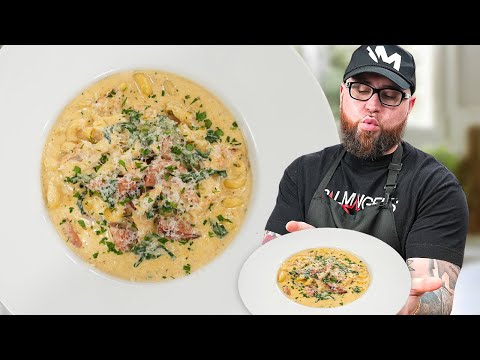
Creamy Chicken Alfredo Soup
Description
The soup’s body relies on a controlled emulsion between butter, cream, and starch from the roux. The butter coats flour granules, moderating hydration and preventing clumping during initial cooking. Once liquid is introduced, the starch swells gradually, thickening the base without separation. The inclusion of grated Parmesan introduces both salt and umami, but also casein proteins that can destabilize if overheated. Maintaining moderate heat ensures the fat phase remains dispersed, yielding a smooth, cohesive texture. Salt should be adjusted only after cheese incorporation to avoid over-seasoning from the cheese’s inherent salinity.
Ingredients
Ingredients
Instructions
Instructions
Step 1
Heat olive oil in a Saucepan over medium heat. Add chopped onion and sauté for 3–4 minutes until translucent. Add minced garlic and cook for 30 seconds until aromatic.Avoid browning the onion; excessive colour will alter the cream base tone and introduce bitterness.Step 2
Add cubed chicken breast and cook for 4–5 minutes until the surface turns opaque. Remove chicken and set aside to prevent overcooking during later simmering.Sear only until the exterior firms; full cooking will occur during the soup simmer to retain moisture.Step 3
In the same Saucepan, melt butter over medium-low heat. Add flour and whisk continuously for 2 minutes to form a pale roux without browning.Maintain steady whisking to prevent flour scorching; colour change indicates excessive heat.Step 4
Gradually add hot chicken stock while whisking to dissolve the roux. Once smooth, return the chicken to the pan and simmer gently for 10 minutes until slightly thickened.Introduce stock in small increments to maintain emulsion stability and prevent lump formation.Step 5
Lower heat to minimum and stir in double cream. Simmer for 5 minutes without boiling. Add grated Parmesan, salt, and black pepper, stirring until cheese fully melts and soup reaches coating consistency.Keep temperature below 90°C to prevent cream curdling and cheese separation.Step 6
Remove from heat and let rest for 5 minutes to allow carryover thickening. Adjust seasoning and garnish with chopped parsley before serving.Resting stabilises the emulsion and allows flavours to integrate; avoid stirring vigorously during this phase.
Recommended Equipment

Nutrition Facts
Servings 4
Serving Size 1 portion
- Amount Per Serving
- Calories 544.71kcal
- % Daily Value *
- Total Fat 40.49g63%
- Saturated Fat 22.32g112%
- Cholesterol 151.08mg51%
- Sodium 813.93mg34%
- Potassium 621.66mg18%
- Total Carbohydrate 16.28g6%
- Dietary Fiber 0.76g4%
- Sugars 6.09g
- Protein 28.98g58%
- Vitamin A 1469.71 IU
- Vitamin C 7.61 mg
- Calcium 246.09 mg
- Iron 1.39 mg
- Vitamin D 1.27 mcg
- Vitamin E 1.52 mg
- Vitamin K 47 mcg
- Thiamin 0.19 mg
- Riboflavin 0.44 mg
- Niacin 11.29 mg
- Vitamin B6 0.78 mg
- Folate 34.11 mcg
- Vitamin B12 0.44 mcg
- Pantothenic Acid 1.39 mg
- Phosphorus 369.54 mg
- Magnesium 44.17 mg
- Zinc 1.41 mg
- Selenium 35.71 mcg
- Copper 0.17 mg
- Manganese 0.16 mg
* Nutrition information is provided as an estimate per serving and may vary depending on the ingredients, brands, substitutions, portion sizes and preparation methods used. Percent Daily Values (%DV) are based on U.S. FDA reference values for a 2,000-calorie diet and are intended as a general guide only. Individual nutritional needs vary. This information is not a substitute for advice from a registered dietitian or other qualified healthcare professional.
Note
Allow the dish to cool gradually before sealing. Rapid temperature shifts can create condensation, weakening texture and diluting surface flavour concentration. The resting phase supports structural stabilisation and moisture redistribution. Cutting or serving too early may compromise internal balance. Dairy-based elements may thicken further upon cooling. Reheat gently to prevent separation or grainy texture. Slow-cooked preparations often improve after several hours or overnight refrigeration as aromatic compounds integrate more fully. Acid balance may soften slightly over time; a final adjustment before serving restores clarity.


