
Recipe Snapshot
Recipe at a Glance
Key timing, yield and style details before you start cooking.
Collagen Extraction and Reduction Dynamics
The structural integrity of a demi-glace depends on controlled collagen extraction from roasted bones and connective tissue. Gelatinisation occurs gradually as simmering water breaks down collagen into soluble gelatin, providing viscosity and mouthfeel. Fat management is critical; rendered fat must be skimmed continuously to prevent emulsification with the stock, which would cloud the final sauce. Acidic tomato paste assists in protein denaturation and flavour deepening, while the mirepoix contributes natural sugars that caramelise during roasting, forming the foundation for Maillard-derived complexity. Salt is withheld until reduction to prevent concentration imbalance during evaporation.
Heat Regulation and Moisture Control
Temperature staging is essential to maintain clarity and depth. The roasting phase requires high dry heat to develop browning without burning, while the simmering phase must remain below a rolling boil to avoid emulsifying impurities. Evaporation rate dictates reduction control; excessive heat accelerates water loss before proper flavour extraction, while insufficient heat yields a weak base. Consistent skimming and surface fat removal maintain purity. The final reduction phase demands precision—over-reduction leads to bitterness and excessive viscosity, under-reduction results in a thin, underdeveloped glaze.
Transformation Through Reduction and Glazing
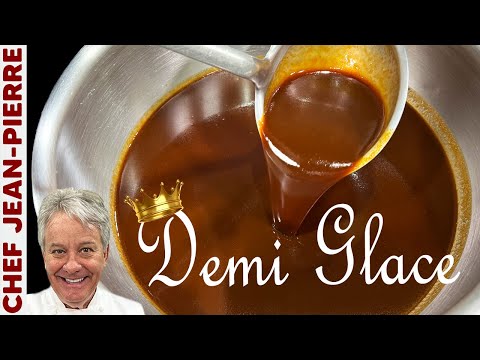
As the sauce reduces, water evaporates and soluble solids concentrate, amplifying umami and sweetness. Gelatin concentration increases, producing a glossy, nappe consistency. Aromatic compounds from roasted vegetables and browned proteins integrate into a cohesive flavour matrix. The transformation from stock to demi-glace represents a shift from hydration-based extraction to controlled dehydration and concentration. The final texture should coat the back of a spoon evenly, indicating proper gelatin structure and reduction balance.
Workflow Efficiency and Batch Coordination
Professional kitchens manage demi-glace production in large batches due to the extended simmering time. Mise en place discipline—pre-roasting bones, pre-measuring tomato paste, and pre-cutting mirepoix—reduces downtime. Parallelisation is achieved by preparing secondary stocks or reductions while the primary stock simmers. Cooling and storage require rapid temperature drop to prevent bacterial growth; shallow containers and ice baths are standard. Reheating must be gentle to preserve emulsion stability and prevent scorching of concentrated sugars and proteins.
Culinary Lineage and Regional Context
Demi-glace originates from classical French cuisine, codified by Escoffier as a mother sauce derivative. It evolved from brown stock (espagnole) reduction, reflecting 19th-century French emphasis on sauce refinement and service consistency. The technique spread through European haute cuisine, influencing modern reductions and pan sauces. Contemporary adaptations may replace veal bones with beef for accessibility, but the structural principle—slow extraction, controlled reduction, and gelatin-based viscosity—remains unchanged across professional kitchens.
Recipe Education
Learn the Skills Behind This Recipe
Build confidence with cooking skills, techniques, and tools used in this recipe.
Cookware Guide
Learn which pots and pans work best for frying, sautéing, simmering, and roasting.
Helpful when using roasting pan during preparation.
How to Roast Properly
Improve roasting with better tray setup, timing, and oven heat balance.
Recommended for the roast method used in this recipe.
Simmer vs Boil
Learn when to simmer, when to boil, and how each affects recipe results.
Recommended for the simmer method used in this recipe.
Oven Temperature Conversions
Understand oven temperatures and how they affect baking and roasting.
Recommended for the roast method used in this recipe.
Batch Cooking
Cook once and prepare multiple meals more efficiently.
Selected for this type of recipe.


Demi-Glace
Description
The structural integrity of a demi-glace depends on controlled collagen extraction from roasted bones and connective tissue. Gelatinisation occurs gradually as simmering water breaks down collagen into soluble gelatin, providing viscosity and mouthfeel. Fat management is critical; rendered fat must be skimmed continuously to prevent emulsification with the stock, which would cloud the final sauce. Acidic tomato paste assists in protein denaturation and flavour deepening, while the mirepoix contributes natural sugars that caramelise during roasting, forming the foundation for Maillard-derived complexity. Salt is withheld until reduction to prevent concentration imbalance during evaporation.
Ingredients
Ingredients
Instructions
Instructions
Step 1
Preheat oven to 220°C. Spread veal bones on a Roasting Pan, drizzle with neutral oil, and roast for 45–60 minutes until deeply browned.Rotate bones halfway through roasting to ensure even caramelisation and prevent scorching.Step 2
Add onion, carrot, celery, and garlic to the Roasting Pan. Continue roasting for 20 minutes until vegetables are browned and aromatic.Avoid overcrowding; excess moisture from vegetables can inhibit proper browning.Step 3
Transfer roasted bones and vegetables to a Stock Pot. Discard excess fat from the pan, then deglaze with a small amount of cold water, scraping browned bits into the pot.Deglazing captures fond, which carries concentrated flavour compounds essential for depth.Step 4
Add tomato paste to the pot and stir over medium heat for 3–4 minutes to caramelise slightly before adding cold water, bay leaf, thyme, and peppercorns.Caramelising tomato paste develops umami and balances acidity before dilution.Step 5
Bring to a gentle simmer, then reduce heat to maintain barely perceptible bubbling. Skim surface impurities regularly and simmer uncovered for 6–8 hours.Maintain sub-boiling temperature to prevent emulsifying fat and clouding the stock.Step 6
Strain through a fine Sieve into a clean Saucepan. Discard solids. Add brown stock and reduce over medium heat until the liquid coats the back of a spoon.Monitor viscosity visually; over-reduction leads to bitterness and stickiness.Step 7
Cool rapidly in shallow containers over an ice bath, then refrigerate or portion and freeze for later use.Rapid cooling prevents bacterial growth and preserves sauce clarity.
Recommended Equipment

Nutrition Facts
Servings 10
Serving Size 1 portion
- Amount Per Serving
- Calories 52.11kcal
- % Daily Value *
- Total Fat 2.96g5%
- Saturated Fat 0.24g2%
- Sodium 492.95mg21%
- Potassium 180.36mg6%
- Total Carbohydrate 6.36g3%
- Dietary Fiber 1.3g6%
- Sugars 3.34g
- Protein 0.76g2%
- Vitamin A 2887.81 IU
- Vitamin C 4.57 mg
- Calcium 34.5 mg
- Iron 0.35 mg
- Vitamin E 0.9 mg
- Vitamin K 9.27 mcg
- Thiamin 0.03 mg
- Riboflavin 0.03 mg
- Niacin 0.41 mg
- Vitamin B6 0.07 mg
- Folate 12.92 mcg
- Pantothenic Acid 0.11 mg
- Phosphorus 20.42 mg
- Magnesium 13.49 mg
- Zinc 0.19 mg
- Copper 0.12 mg
- Manganese 0.1 mg
* Nutrition information is provided as an estimate per serving and may vary depending on the ingredients, brands, substitutions, portion sizes and preparation methods used. Percent Daily Values (%DV) are based on U.S. FDA reference values for a 2,000-calorie diet and are intended as a general guide only. Individual nutritional needs vary. This information is not a substitute for advice from a registered dietitian or other qualified healthcare professional.
Note
Allow the dish to cool gradually before sealing. Rapid temperature shifts can create condensation, weakening texture and diluting surface flavour concentration. The resting phase supports structural stabilisation and moisture redistribution. Cutting or serving too early may compromise internal balance. Spice intensity can deepen over time as volatile compounds settle. Taste and adjust seasoning after resting. In larger batches, maintain even heat distribution and avoid overcrowding during reheating to preserve structural integrity. Slow-cooked preparations often improve after several hours or overnight refrigeration as aromatic compounds integrate more fully. Texture refinement often occurs naturally during resting due to internal moisture redistribution.


