
Recipe Snapshot
Recipe at a Glance
Key timing, yield and style details before you start cooking.
Batter Composition and Hydration Control
Dorayaki batter depends on balanced hydration between egg proteins and wheat starch. The inclusion of honey and sugar modifies viscosity and moisture retention, preventing excessive toughness after cooking. Baking powder provides controlled aeration, while milk adjusts fluidity to achieve a pourable but cohesive consistency. Overmixing activates gluten excessively, resulting in rubbery texture, so mixing should stop once the batter is smooth. Resting the batter allows starch granules to hydrate evenly, stabilising viscosity and ensuring uniform browning. The sugar and honey also promote Maillard reaction, giving the characteristic amber surface without requiring high heat.
Heat Regulation and Surface Control
Cooking dorayaki requires precise temperature staging. The Non-stick Skillet must be preheated to medium-low to prevent premature browning before internal setting. A thin film of oil is wiped off to maintain even contact without frying. Each pancake is cooked until small bubbles form and the surface loses gloss, indicating partial gelatinisation. Immediate flipping ensures even colour and minimal moisture loss. Carryover heat continues to set the interior after removal, so overcooking must be avoided. Consistent diameter and thickness are critical for uniform pairing during assembly.
Textural Transformation and Filling Integration
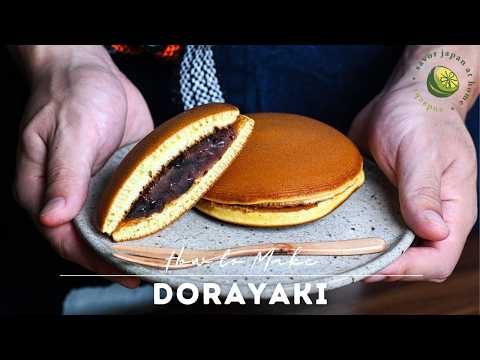
During cooking, proteins denature and starch gelatinises, forming a flexible yet resilient crumb. The honey’s invert sugars retain moisture, keeping the pancakes soft even after cooling. When assembling, the warm pancakes slightly soften the red bean paste, allowing it to spread evenly without tearing the surface. The filling’s moisture content must be controlled; overly wet anko will cause sogginess, while too dry will resist adhesion. Proper sealing around the edges prevents leakage and maintains a clean dome profile typical of professional dorayaki presentation.
Workflow Efficiency and Assembly Timing
Efficient production relies on staging: batter resting, portioning, and sequential cooking. While one batch cooks, the next portion should be portioned to maintain rhythm. Pancakes must cool briefly before filling to prevent condensation. Using a consistent ladle volume ensures identical size for pairing. In service environments, pre-cooked pancakes can be held covered at room temperature for short periods, but filled units should be assembled close to service to preserve texture contrast between the soft cake and dense filling.
Regional Technique Lineage and Adaptation
Dorayaki originates from Japan, evolving from earlier castella-style confections influenced by Portuguese sponge techniques. The modern sandwich form emerged in the early 20th century with the introduction of refined sugar and baking powder. The use of anko (sweet red bean paste) reflects traditional Japanese sweet-making, where legumes serve as primary sweet carriers. Contemporary adaptations may include custard or matcha fillings, but the structural principle—two honey-enriched pancakes enclosing a moist core—remains consistent across regional variations.
Recipe Education
Learn the Skills Behind This Recipe
Build confidence with cooking skills, techniques, and tools used in this recipe.
How to Fry Properly
Understand pan heat, oil temperature, and how to get better frying results.
Recommended for the fry method used in this recipe.
Cups to Grams
Convert cup measurements more accurately to improve recipe consistency.
Helpful when using measuring cups during preparation.
Teaspoons to Grams
Use small-measure conversions more accurately in cooking and baking.
Helpful when using measuring spoons during preparation.
Baking Tools Guide
Understand essential tools for mixing, measuring, and preparing recipes.
Helpful when using mixing bowl during preparation.


Dorayaki (Red Bean Pancakes)
Description
Dorayaki batter depends on balanced hydration between egg proteins and wheat starch. The inclusion of honey and sugar modifies viscosity and moisture retention, preventing excessive toughness after cooking. Baking powder provides controlled aeration, while milk adjusts fluidity to achieve a pourable but cohesive consistency. Overmixing activates gluten excessively, resulting in rubbery texture, so mixing should stop once the batter is smooth. Resting the batter allows starch granules to hydrate evenly, stabilising viscosity and ensuring uniform browning. The sugar and honey also promote Maillard reaction, giving the characteristic amber surface without requiring high heat.
Ingredients
Ingredients
Instructions
Instructions
Step 1
In a Mixing Bowl, whisk eggs, caster sugar, and honey until pale and slightly thickened. Add baking powder and mix briefly to combine.Whisking incorporates air that supports light structure; avoid overbeating to prevent excessive foam collapse during resting.Step 2
Sift all-purpose flour into the egg mixture and fold gently with a Silicone Spatula until just combined. Gradually add milk until a smooth, pourable batter forms.Add milk incrementally to control viscosity; the batter should ribbon slowly from the spatula without breaking.Step 3
Cover the bowl with Cling Film and rest the batter for 15 minutes at room temperature to allow starch hydration and bubble stabilization.Resting relaxes gluten and ensures even browning; skipping this step can cause uneven surface texture.Step 4
Heat a Non-stick Skillet over medium-low heat. Lightly oil with a Silicone Spatula or paper towel, then wipe off excess. Pour 2 tbsp of batter per pancake and cook until small bubbles appear and the surface loses gloss, about 1–2 minutes.Maintain consistent skillet temperature; overheating darkens the surface before internal set is achieved.Step 5
Flip each pancake and cook for another 30–45 seconds until golden brown. Transfer to a Cooling Rack and cover lightly with a Tea Towel to retain moisture.Covering traps residual steam, keeping the pancakes pliable for later assembly.Step 6
Once cooled slightly, spread 1–2 tbsp of sweet red bean paste on the underside of one pancake and top with another, pressing gently around the edges to seal.Apply filling while pancakes are warm but not hot; this ensures adhesion without melting the paste.
Recommended Equipment

Nutrition Facts
Servings 4
Serving Size 1 portion
- Amount Per Serving
- Calories 312.02kcal
- % Daily Value *
- Total Fat 4.04g7%
- Saturated Fat 1.06g6%
- Cholesterol 93.93mg32%
- Sodium 161.15mg7%
- Potassium 81.16mg3%
- Total Carbohydrate 79.14g27%
- Dietary Fiber 2.27g10%
- Sugars 28.64g
- Protein 8.94g18%
- Vitamin A 147.53 IU
- Calcium 105.6 mg
- Iron 2.68 mg
- Vitamin D 0.59 mcg
- Vitamin E 0.48 mg
- Thiamin 0.25 mg
- Riboflavin 0.28 mg
- Niacin 1.8 mg
- Vitamin B6 0.06 mg
- Folate 66.75 mcg
- Vitamin B12 0.26 mcg
- Pantothenic Acid 0.55 mg
- Phosphorus 115.12 mg
- Magnesium 10.94 mg
- Zinc 0.57 mg
- Selenium 18.04 mcg
- Copper 0.06 mg
- Manganese 0.22 mg
* Nutrition information is provided as an estimate per serving and may vary depending on the ingredients, brands, substitutions, portion sizes and preparation methods used. Percent Daily Values (%DV) are based on U.S. FDA reference values for a 2,000-calorie diet and are intended as a general guide only. Individual nutritional needs vary. This information is not a substitute for advice from a registered dietitian or other qualified healthcare professional.
Note
Store in an airtight container under refrigeration, ensuring minimal air exposure to preserve flavour integrity and textural balance. The resting phase supports structural stabilisation and moisture redistribution. Cutting or serving too early may compromise internal balance. Dairy-based elements may thicken further upon cooling. Reheat gently to prevent separation or grainy texture. Monitor seasoning levels after storage, as salt perception can shift once chilled.


