
Recipe Snapshot
Recipe at a Glance
Key timing, yield and style details before you start cooking.
Fermented Base and Umami Structure
The foundation of Dwenjang Guk lies in the controlled use of fermented soybean paste, which provides glutamate-driven depth and salinity. The paste’s enzymatic breakdown of soy proteins into amino acids enhances savoury perception while contributing viscosity through residual solids. Balancing this intensity requires calibrated dilution with stock to prevent excessive salt concentration. The inclusion of aromatics such as garlic and onion introduces sulphur compounds that round the fermentation sharpness. Vegetables like zucchini and tofu contribute water activity and mild sweetness, stabilising the broth’s salinity gradient. The sequencing of ingredient addition is critical—fermented paste must dissolve fully before delicate vegetables are introduced to avoid uneven seasoning and textural degradation.
Thermal Regulation and Broth Clarity
Temperature staging defines the soup’s clarity and flavour precision. The soybean paste must be dispersed in simmering stock rather than boiling liquid to prevent protein coagulation that clouds the broth. Maintaining a steady medium simmer allows volatile aromatics to integrate without excessive evaporation. Overheating risks bitterness from burnt paste residues, while insufficient heat limits flavour extraction from anchovy or kelp stock. Controlled simmering for 15–20 minutes ensures balanced reduction and flavour concentration without over-thickening. The tofu and zucchini are added late to preserve structural integrity, as prolonged exposure to heat would cause cell wall collapse and textural mushiness.
Transformation Through Simmering
During the simmering phase, the broth undergoes gradual flavour layering. The dissolved soybean paste emulsifies with the stock’s natural fats, creating a stable suspension that carries flavour evenly. Vegetables soften through pectin breakdown, releasing mild sugars that temper the paste’s saltiness. The tofu absorbs the seasoned liquid, acting as a neutral carrier of umami. The final texture should be lightly viscous but fluid, with suspended solids evenly distributed. The soup’s aroma evolves as sulphur compounds mellow and Maillard-derived notes from the paste deepen. Proper timing ensures the broth remains cohesive without stratification or sedimentation.
Workflow Efficiency and Sequencing Logic
Efficient mise en place reduces thermal fluctuation and prevents over-reduction. Preparing the stock base separately allows rapid assembly during service. Dissolving the soybean paste through a sieve ensures even dispersion and eliminates clumps that can scorch. Vegetables should be pre-cut to uniform thickness for consistent cooking rates. Parallel preparation of garnish elements such as sliced spring onion allows immediate finishing without interrupting simmer control. The workflow should maintain a single active burner phase, minimising idle time and ensuring the soup reaches the pass at optimal temperature and consistency.
Cultural and Regional Context
Dwenjang Guk originates from Korean temple and home cooking traditions, where fermented soybean paste (dwenjang) served as a preserved protein source. The soup evolved as a daily meal component, distinct from the thicker dwenjang jjigae by its lighter broth and reduced oil content. Regional variations exist—coastal areas often use anchovy stock, while inland regions favour kelp or vegetable bases. The dish exemplifies Korean fermentation logic, where microbial transformation extends shelf life and deepens flavour complexity. Modern adaptations maintain traditional fermentation principles while refining clarity and balance for contemporary service environments.
Recipe Education
Learn the Skills Behind This Recipe
Build confidence with cooking skills, techniques, and tools used in this recipe.
How to Boil Properly
Learn boiling times, temperature control, and how to avoid overcooking.
Recommended for the boil method used in this recipe.
Simmer vs Boil
Learn when to simmer, when to boil, and how each affects recipe results.
Recommended for the simmer method used in this recipe.
Cookware Guide
Learn which pots and pans work best for frying, sautéing, simmering, and roasting.
Helpful when using saucepan during preparation.
Teaspoons to Grams
Use small-measure conversions more accurately in cooking and baking.
Helpful when using measuring spoons during preparation.
Baking Tools Guide
Understand essential tools for mixing, measuring, and preparing recipes.
Helpful when using mixing bowl during preparation.
Cooking Basics
Build safer knife preparation, heat control, timing, and everyday kitchen confidence.
Helpful when using chef knife during preparation.


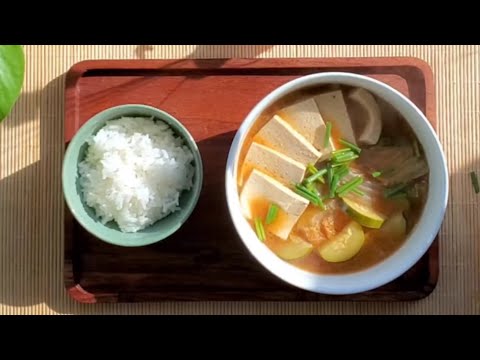
Dwenjang Guk (Soybean Paste Soup)
Description
The foundation of Dwenjang Guk lies in the controlled use of fermented soybean paste, which provides glutamate-driven depth and salinity. The paste’s enzymatic breakdown of soy proteins into amino acids enhances savoury perception while contributing viscosity through residual solids. Balancing this intensity requires calibrated dilution with stock to prevent excessive salt concentration. The inclusion of aromatics such as garlic and onion introduces sulphur compounds that round the fermentation sharpness. Vegetables like zucchini and tofu contribute water activity and mild sweetness, stabilising the broth’s salinity gradient. The sequencing of ingredient addition is critical—fermented paste must dissolve fully before delicate vegetables are introduced to avoid uneven seasoning and textural degradation.
Ingredients
Ingredients
Instructions
Instructions
Step 1
Bring the anchovy-kelp stock to a gentle simmer in a Saucepan over medium heat. Skim any surface foam to maintain clarity.Avoid vigorous boiling at this stage to prevent emulsifying fish oils that can cloud the broth.Step 2
Place the dwenjang in a small Mixing Bowl, ladle in some hot stock, and stir until smooth. Strain the mixture through a Sieve back into the Saucepan.Passing the paste through a sieve ensures even dispersion and prevents undissolved solids from settling at the bottom.Step 3
Add onion and garlic to the simmering broth and cook for 5 minutes until aromatic compounds mellow and sweetness develops.Maintain a steady medium simmer to extract flavour without caramelising the garlic, which would introduce bitterness.Step 4
Add zucchini and tofu to the pot and continue simmering for 10 minutes until the zucchini softens and tofu is heated through.Introduce vegetables only after the broth stabilises to prevent overcooking and maintain structural definition.Step 5
Adjust seasoning with soy sauce and optional gochugaru. Finish with sesame oil and garnish with sliced spring onion before serving.Add sesame oil off heat to preserve its volatile aroma compounds and prevent oxidation.
Recommended Equipment

Nutrition Facts
Servings 4
Serving Size 1 portion
- Amount Per Serving
- Calories 370.97kcal
- % Daily Value *
- Total Fat 14.48g23%
- Saturated Fat 3.52g18%
- Cholesterol 150mg50%
- Sodium 439.31mg19%
- Potassium 1050.32mg31%
- Total Carbohydrate 2.98g1%
- Dietary Fiber 0.85g4%
- Sugars 1.14g
- Protein 53.93g108%
- Vitamin A 338.44 IU
- Vitamin C 5.03 mg
- Calcium 409.66 mg
- Iron 8.73 mg
- Vitamin E 1.67 mg
- Vitamin K 7.02 mcg
- Thiamin 0.16 mg
- Riboflavin 0.67 mg
- Niacin 35.36 mg
- Vitamin B6 0.43 mg
- Folate 31.5 mcg
- Vitamin B12 1.55 mcg
- Pantothenic Acid 1.69 mg
- Phosphorus 452.97 mg
- Magnesium 109.73 mg
- Zinc 4.43 mg
- Selenium 91.59 mcg
- Copper 0.56 mg
- Manganese 0.26 mg
* Nutrition information is provided as an estimate per serving and may vary depending on the ingredients, brands, substitutions, portion sizes and preparation methods used. Percent Daily Values (%DV) are based on U.S. FDA reference values for a 2,000-calorie diet and are intended as a general guide only. Individual nutritional needs vary. This information is not a substitute for advice from a registered dietitian or other qualified healthcare professional.
Note
Allow the dish to cool gradually before sealing. Rapid temperature shifts can create condensation, weakening texture and diluting surface flavour concentration. Slow-cooked preparations often improve after several hours or overnight refrigeration as aromatic compounds integrate more fully. Texture refinement often occurs naturally during resting due to internal moisture redistribution.


