
Recipe Snapshot
Recipe at a Glance
Key timing, yield and style details before you start cooking.
Starch Gelation and Fat Interaction in Taro Dough
Taro’s starch composition requires controlled hydration and fat integration to achieve the signature flaky-crisp shell. The dough relies on a hot-water gelatinisation phase to partially cook the starch, allowing it to trap air during frying. Lard or neutral oil is incorporated to create micro-layers that expand under heat, producing a honeycomb-like texture. Salt stabilises the structure by tightening the starch network, while minimal water prevents collapse. The filling’s moisture must be balanced to avoid steam rupture during frying; excess liquid destabilises the outer matrix and inhibits proper blistering.
Temperature Control and Moisture Management During Frying
Precise oil temperature staging is critical. The dumplings are introduced at moderate heat to allow internal expansion before the crust sets, then finished at higher temperature to drive off residual moisture and achieve crispness. Overheating causes premature crust formation, trapping steam and leading to bursting. Underheating results in oil absorption and soggy texture. Maintaining consistent oil depth and avoiding crowding ensures even convection. The taro dough’s porous structure demands careful monitoring of bubble activity as an indicator of internal dehydration and readiness.
Textural Transformation Through Dual-Phase Cooking
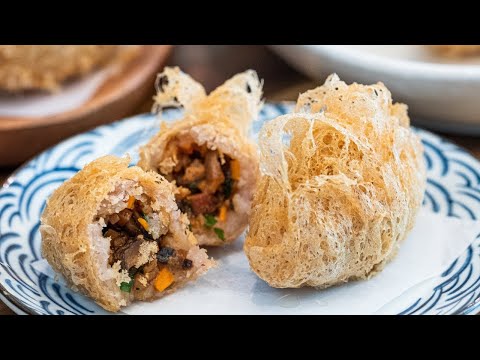
The transformation from dense taro paste to aerated shell occurs through controlled gelatinisation and rapid dehydration. As the dumpling fries, the outer layer expands, forming a lace-like crust while the interior remains tender. The filling’s savoury base—typically minced pork and aromatics—develops Maillard depth, contrasting the mild taro. The internal fat renders slightly, enriching the crumb and preventing dryness. Proper resting post-fry allows residual steam to escape, stabilising the crisp network and preventing collapse during service.
Workflow Efficiency and Component Coordination
Efficient production requires staging: taro steaming, dough formation, filling preparation, shaping, and final frying. Cooling the taro before mashing prevents excess stickiness. Filling should be pre-cooked and cooled to avoid moisture migration. Shaping must be consistent in size to ensure uniform frying. In professional settings, pre-shaped dumplings can be held under refrigeration for short periods, but extended storage risks condensation and structural weakening. Parallel preparation of filling and dough reduces downtime and maintains workflow continuity.
Regional Technique Lineage and Adaptation
Fried taro dumplings, known as ‘Wu Gok’ in Cantonese dim sum tradition, originate from southern Chinese banquet cuisine. The method evolved from early yam fritters, refined through Cantonese mastery of texture contrast. The signature lace crust results from precise control of taro starch hydration and lard aeration, a hallmark of Hong Kong dim sum craftsmanship. Modern adaptations may substitute vegetable oil for lard, but this alters expansion behaviour and flavour depth. The dish remains a technical benchmark for dim sum chefs, reflecting regional precision in frying technique.
Recipe Education
Learn the Skills Behind This Recipe
Build confidence with cooking skills, techniques, and tools used in this recipe.
Cookware Guide
Learn which pots and pans work best for frying, sautéing, simmering, and roasting.
Helpful when using frying pan during preparation.
How to Fry Properly
Understand pan heat, oil temperature, and how to get better frying results.
Recommended for the fry method used in this recipe.
Cooking Basics
Build safer knife preparation, heat control, timing, and everyday kitchen confidence.
Helpful when using chef knife during preparation.
Baking Tools Guide
Understand essential tools for mixing, measuring, and preparing recipes.
Helpful when using mixing bowl during preparation.


Fried Taro Dumplings
Description
Taro’s starch composition requires controlled hydration and fat integration to achieve the signature flaky-crisp shell. The dough relies on a hot-water gelatinisation phase to partially cook the starch, allowing it to trap air during frying. Lard or neutral oil is incorporated to create micro-layers that expand under heat, producing a honeycomb-like texture. Salt stabilises the structure by tightening the starch network, while minimal water prevents collapse. The filling’s moisture must be balanced to avoid steam rupture during frying; excess liquid destabilises the outer matrix and inhibits proper blistering.
Ingredients
Ingredients
Instructions
Instructions
Step 1
Steam the taro root in a Steamer Basket over boiling water until fully tender, about 20 minutes. Drain and mash while warm until smooth.Mash taro while still hot to ensure full starch gelatinisation and prevent grainy texture.Step 2
In a Mixing Bowl, combine wheat starch with boiling water and mix quickly using a Silicone Spatula to form a translucent paste. Incorporate mashed taro, lard, and half the salt to form a pliable dough.Add boiling water gradually; overhydration weakens the dough and reduces expansion during frying.Step 3
In a Frying Pan, sauté minced pork and diced onion over medium heat until lightly browned. Add soy sauce, oyster sauce, sugar, and remaining salt. Cook until moisture evaporates, then cool completely.Allow filling to cool fully before shaping to prevent steam from softening the taro dough.Step 4
Divide taro dough into 20 g portions. Flatten each piece, add a small spoon of filling, and seal tightly. Shape into ovals with pointed ends.Keep hands lightly oiled to prevent sticking and tearing of the delicate dough.Step 5
Heat vegetable oil in a Wok to 160°C. Fry dumplings in small batches until they expand and turn golden brown, about 4–5 minutes. Drain on a Cooling Rack.Maintain oil temperature between 155–165°C; fluctuations cause uneven crust formation and oil absorption.Step 6
Rest dumplings for 3 minutes before serving to allow internal steam to dissipate and crust to stabilise.Avoid covering freshly fried dumplings; trapped steam softens the crisp lattice structure.
Recommended Equipment

Nutrition Facts
Servings 8
Serving Size 1 portion
- Amount Per Serving
- Calories 664.99kcal
- % Daily Value *
- Total Fat 61.71g95%
- Saturated Fat 10.29g52%
- Cholesterol 13.5mg5%
- Sodium 394.92mg17%
- Potassium 457.56mg14%
- Total Carbohydrate 25.21g9%
- Dietary Fiber 2.87g12%
- Sugars 0.65g
- Protein 4.36g9%
- Vitamin C 2.88 mg
- Calcium 32.86 mg
- Iron 0.62 mg
- Vitamin E 6.31 mg
- Vitamin K 106.6 mcg
- Thiamin 0.2 mg
- Riboflavin 0.06 mg
- Niacin 1.26 mg
- Vitamin B6 0.25 mg
- Folate 14.23 mcg
- Vitamin B12 0.13 mcg
- Pantothenic Acid 0.32 mg
- Phosphorus 92.49 mg
- Magnesium 26.48 mg
- Zinc 0.57 mg
- Selenium 5.37 mcg
- Copper 0.13 mg
- Manganese 0.26 mg
* Nutrition information is provided as an estimate per serving and may vary depending on the ingredients, brands, substitutions, portion sizes and preparation methods used. Percent Daily Values (%DV) are based on U.S. FDA reference values for a 2,000-calorie diet and are intended as a general guide only. Individual nutritional needs vary. This information is not a substitute for advice from a registered dietitian or other qualified healthcare professional.
Note
For best structural retention, cool uncovered briefly before storage to prevent trapped steam from softening exterior crust or caramelised surfaces. The resting phase supports structural stabilisation and moisture redistribution. Cutting or serving too early may compromise internal balance. In larger batches, maintain even heat distribution and avoid overcrowding during reheating to preserve structural integrity. When reheating crisp components, use dry heat rather than microwave methods to maintain exterior texture. Acid balance may soften slightly over time; a final adjustment before serving restores clarity.


