
Recipe Snapshot
Recipe at a Glance
Key timing, yield and style details before you start cooking.
Fat Integration and Spice Hydration Control
The structural base of Gaeng Kari Moo depends on the controlled emulsification between coconut fat and the aqueous curry phase. Coconut milk’s fat content must be stable under medium heat to prevent separation, allowing the yellow curry paste’s oil-soluble aromatics—turmeric, cumin, and coriander—to bloom effectively. The paste’s hydration level determines how evenly these spices disperse, influencing both mouthfeel and visual consistency. Salt and fish sauce act as ionic stabilisers, tightening the emulsion while balancing sweetness from palm sugar. Proper sequencing—paste before protein, protein before liquid—ensures the fat coats the pork evenly, locking in flavour before dilution occurs.
Temperature Staging and Moisture Retention
Heat management defines the curry’s body and clarity. The initial sautéing of curry paste in coconut cream requires medium heat to trigger Maillard reactions without burning the aromatics. Once the paste releases oil, the pork is introduced to sear lightly, sealing surface proteins. Subsequent simmering must remain below a rolling boil to prevent coconut milk from splitting. Evaporation control is critical—too rapid and the sauce thickens prematurely, too slow and the flavour remains flat. Maintaining a steady simmer allows collagen in the pork shoulder to convert to gelatin, enriching the sauce’s viscosity naturally.
Transformation Through Simmering and Reduction
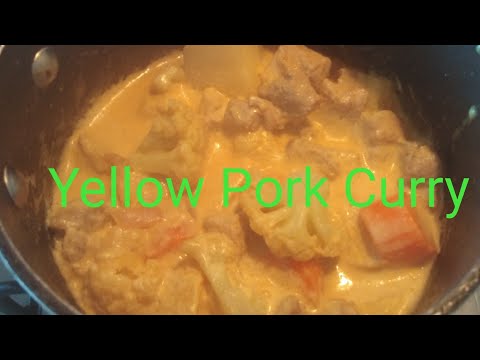
During the simmering phase, the curry transitions from a raw spice suspension to a cohesive sauce. The starch from potatoes and the gelatin from pork integrate to create a smooth, coating texture. Reduction concentrates the spice oils and balances sweetness against savoury depth. The turmeric’s pigment stabilises under moderate heat, producing a consistent golden hue. The final texture should cling lightly to the spoon, indicating proper emulsification and reduction. Over-reduction risks salt concentration and fat separation, while under-reduction leaves the curry watery and underdeveloped in flavour.
Workflow Efficiency and Sequencing Logic
Efficient mise en place is essential. Curry paste, coconut milk, and aromatics should be pre-measured and staged near the heat source to maintain continuous workflow. Potatoes should be par-cooked separately or added at the correct stage to align their doneness with the pork’s tenderness. Parallel preparation—such as slicing pork while the paste blooms—reduces idle time. Avoid crowding the pan during searing to maintain temperature stability. Consistent stirring during reduction prevents scorching at the base, a common failure point in high-fat curries.
Regional Technique Lineage and Adaptation
Gaeng Kari Moo originates from central Thai culinary adaptation of Indian-influenced yellow curry, adjusted for local palates through coconut enrichment and palm sugar balancing. The inclusion of pork reflects regional availability and non-halal dietary norms distinct from southern Thai Muslim curries. The spice blend evolved to moderate heat intensity, focusing on aromatic depth rather than capsaicin dominance. Modern Thai kitchens maintain the traditional simmering method but often employ pre-made curry pastes for consistency. The dish exemplifies Thailand’s integration of imported spice techniques into a coconut-based sauce system.
Recipe Education
Learn the Skills Behind This Recipe
Build confidence with cooking skills, techniques, and tools used in this recipe.
How to Sauté Properly
Master fast cooking, pan heat, and ingredient timing for better texture.
Recommended for the saute method used in this recipe.
Simmer vs Boil
Learn when to simmer, when to boil, and how each affects recipe results.
Recommended for the simmer method used in this recipe.
Cookware Guide
Learn which pots and pans work best for frying, sautéing, simmering, and roasting.
Helpful when using frying pan during preparation.
Cups to Grams
Convert cup measurements more accurately to improve recipe consistency.
Helpful when using measuring cups during preparation.
Teaspoons to Grams
Use small-measure conversions more accurately in cooking and baking.
Helpful when using measuring spoons during preparation.
Baking Tools Guide
Understand essential tools for mixing, measuring, and preparing recipes.
Helpful when using mixing bowl during preparation.


Gaeng Kari Moo (Pork Yellow Curry)
Description
The structural base of Gaeng Kari Moo depends on the controlled emulsification between coconut fat and the aqueous curry phase. Coconut milk’s fat content must be stable under medium heat to prevent separation, allowing the yellow curry paste’s oil-soluble aromatics—turmeric, cumin, and coriander—to bloom effectively. The paste’s hydration level determines how evenly these spices disperse, influencing both mouthfeel and visual consistency. Salt and fish sauce act as ionic stabilisers, tightening the emulsion while balancing sweetness from palm sugar. Proper sequencing—paste before protein, protein before liquid—ensures the fat coats the pork evenly, locking in flavour before dilution occurs.
Ingredients
Ingredients
Instructions
Instructions
Step 1
Heat vegetable oil in a Saute Pan over medium heat. Add yellow curry paste and stir continuously for 1–2 minutes until aromatic and oil separates.Maintain medium heat; excessive temperature will scorch the paste and create bitterness.Step 2
Add half of the coconut milk and cook, stirring, until the mixture thickens and the oil begins to surface.Use the fat layer of coconut milk first; it stabilises the emulsion and enhances spice blooming.Step 3
Add pork shoulder cubes and stir to coat evenly with the curry base. Sear lightly for 3–4 minutes until the exterior firms.Do not overcrowd the pan; surface contact ensures even browning and prevents steaming.Step 4
Pour in the remaining coconut milk and water. Add onion and potatoes. Bring to a gentle simmer, then reduce heat to low.Keep the simmer below boiling point to avoid coconut milk separation and maintain sauce cohesion.Step 5
Add fish sauce, palm sugar, turmeric powder, and salt. Stir well and simmer uncovered for 35–40 minutes until pork is tender and sauce thickens.Monitor reduction visually; sauce should coat the back of a spoon without oil pooling on top.Step 6
Adjust seasoning with lime juice before serving. Stir gently to integrate acidity evenly.Add lime juice off heat to preserve brightness and prevent curdling of the coconut base.
Recommended Equipment

Nutrition Facts
Servings 4
Serving Size 1 portion
- Amount Per Serving
- Calories 437.63kcal
- % Daily Value *
- Total Fat 31g48%
- Saturated Fat 21.13g106%
- Cholesterol 61.31mg21%
- Sodium 1384.97mg58%
- Potassium 869.76mg25%
- Total Carbohydrate 20.56g7%
- Dietary Fiber 2.25g9%
- Sugars 4.63g
- Protein 22.01g45%
- Vitamin A 1191.49 IU
- Vitamin C 17.98 mg
- Calcium 62.34 mg
- Iron 5.32 mg
- Vitamin E 0.32 mg
- Vitamin K 7.65 mcg
- Thiamin 0.9 mg
- Riboflavin 0.32 mg
- Niacin 5.45 mg
- Vitamin B6 0.67 mg
- Folate 38.35 mcg
- Vitamin B12 0.81 mcg
- Pantothenic Acid 1.12 mg
- Phosphorus 322.76 mg
- Magnesium 98.16 mg
- Zinc 3.69 mg
- Selenium 28.17 mcg
- Copper 0.4 mg
- Manganese 0.94 mg
* Nutrition information is provided as an estimate per serving and may vary depending on the ingredients, brands, substitutions, portion sizes and preparation methods used. Percent Daily Values (%DV) are based on U.S. FDA reference values for a 2,000-calorie diet and are intended as a general guide only. Individual nutritional needs vary. This information is not a substitute for advice from a registered dietitian or other qualified healthcare professional.
Note
Allow the dish to cool gradually before sealing. Rapid temperature shifts can create condensation, weakening texture and diluting surface flavour concentration. The resting phase supports structural stabilisation and moisture redistribution. Cutting or serving too early may compromise internal balance. Dairy-based elements may thicken further upon cooling. Reheat gently to prevent separation or grainy texture. Slow-cooked preparations often improve after several hours or overnight refrigeration as aromatic compounds integrate more fully. When reheating crisp components, use dry heat rather than microwave methods to maintain exterior texture. Texture refinement often occurs naturally during resting due to internal moisture redistribution.


