
Recipe Snapshot
Recipe at a Glance
Key timing, yield and style details before you start cooking.
Ingredient Matrix and Structural Balance
Massaman curry relies on a controlled balance between fat, acid, and aromatic density. Coconut milk provides the lipid phase that carries the spice paste’s volatile compounds, while the beef’s collagen contributes gelatin for body. Tamarind and lime juice introduce acidity to counteract the coconut’s richness, preventing palate fatigue. Palm sugar moderates the salt and acid, ensuring roundness without sweetness dominance. The starch contribution from potatoes stabilises the sauce’s viscosity during reduction, while roasted peanuts add both flavour depth and emulsification support. Proper sequencing—frying the paste in coconut cream before adding liquids—activates the spice oils and prevents raw aromatics from dulling the final flavour.
Thermal Control and Moisture Management
Temperature staging defines the curry’s success. The initial high heat bloom of the paste in coconut cream must be brief to avoid scorching while ensuring full oil separation. Once beef and liquids are introduced, the process transitions to low simmering, maintaining sub-boiling conditions to tenderise connective tissue without emulsified fat breaking. Evaporation must be gradual; excessive reduction before beef softens leads to uneven texture and over-concentration of salt. Covering the pot partially allows moisture retention while still permitting controlled reduction. Monitoring the surface for consistent gentle bubbling ensures the sauce thickens through natural gelatin release rather than forced evaporation.
Transformation and Flavour Integration
During the long simmer, collagen in the beef converts to gelatin, thickening the curry and giving it a velvety mouthfeel. The spice paste’s aromatics—cinnamon, cardamom, clove, and nutmeg—undergo oil-based extraction, deepening their complexity. The coconut milk’s fat phase integrates with the beef’s rendered fat, forming a stable emulsion that coats each ingredient evenly. Potatoes absorb both salt and spice, acting as flavour carriers. The final stage of resting allows volatile aromatics to stabilise and the sauce to tighten slightly as gelatin sets. This resting phase is critical for achieving the cohesive, glossy texture characteristic of a properly executed Massaman.
Workflow Efficiency and Sequencing Logic
Professional execution requires parallel preparation: spice paste measured and ready, coconut milk separated into cream and milk portions, and beef trimmed and portioned before heat application. Potatoes should be par-cooked separately to prevent starch clouding the sauce. Mise en place discipline avoids overcooking the paste while searching for missing components. Once simmering begins, periodic skimming maintains clarity. In service environments, the curry can be held at low heat for extended periods without degradation if fat separation is controlled. Reheating must be gentle to preserve emulsion integrity and prevent coconut fat from splitting.
Cultural and Technical Lineage
Massaman curry originates from southern Thailand, influenced by Persian and Malay spice trade routes. The inclusion of warm spices such as cinnamon, cardamom, and clove reflects historical Islamic culinary influence, distinct from central Thai curries that rely on fresh herbs. The technique of frying the paste in coconut cream before dilution evolved to maximise aromatic extraction in fat-based mediums. Modern versions often use beef for its collagen yield and compatibility with slow braising. The dish exemplifies Thailand’s adaptive integration of imported spices into a coconut-based curry framework, maintaining balance between sweetness, acidity, and spice warmth.
Recipe Education
Learn the Skills Behind This Recipe
Build confidence with cooking skills, techniques, and tools used in this recipe.
How to Sauté Properly
Master fast cooking, pan heat, and ingredient timing for better texture.
Recommended for the saute method used in this recipe.
Simmer vs Boil
Learn when to simmer, when to boil, and how each affects recipe results.
Recommended for the simmer method used in this recipe.
Cookware Guide
Learn which pots and pans work best for frying, sautéing, simmering, and roasting.
Helpful when using dutch oven during preparation.
Cups to Grams
Convert cup measurements more accurately to improve recipe consistency.
Helpful when using measuring cups during preparation.
Teaspoons to Grams
Use small-measure conversions more accurately in cooking and baking.
Helpful when using measuring spoons during preparation.
Cooking Basics
Build safer knife preparation, heat control, timing, and everyday kitchen confidence.
Helpful when using chef knife during preparation.


Gaeng Massaman Nua (Beef Massaman Curry)
Description
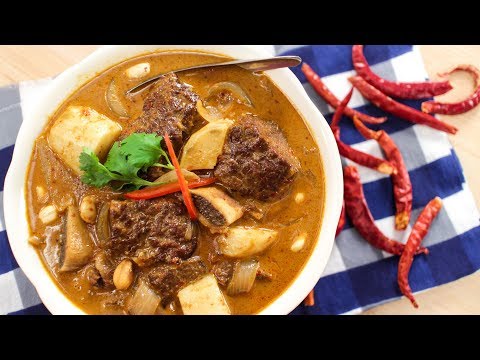
Massaman curry relies on a controlled balance between fat, acid, and aromatic density. Coconut milk provides the lipid phase that carries the spice paste’s volatile compounds, while the beef’s collagen contributes gelatin for body. Tamarind and lime juice introduce acidity to counteract the coconut’s richness, preventing palate fatigue. Palm sugar moderates the salt and acid, ensuring roundness without sweetness dominance. The starch contribution from potatoes stabilises the sauce’s viscosity during reduction, while roasted peanuts add both flavour depth and emulsification support. Proper sequencing—frying the paste in coconut cream before adding liquids—activates the spice oils and prevents raw aromatics from dulling the final flavour.
Ingredients
Ingredients
Instructions
Instructions
Step 1
Heat vegetable oil and half of the coconut cream in a Dutch Oven over medium heat until the surface begins to separate. Add the Massaman curry paste and fry for 3–4 minutes until aromatic and oil rises to the top.Maintain medium heat; excessive temperature scorches the paste before aromatic oils release properly.Step 2
Add beef cubes and stir to coat evenly in the fried paste. Cook for 5 minutes until lightly browned on all sides.Ensure each piece contacts the base; browning develops Maillard depth that anchors the sauce flavour.Step 3
Add remaining coconut milk, water, cinnamon stick, cardamom pods, and bay leaves. Bring to a gentle simmer, then reduce heat to low and cover partially.Keep the simmer below boiling; rolling boil causes coconut fat separation and toughens connective tissue.Step 4
Simmer for 60–75 minutes until beef is tender. Skim any surface fat or foam periodically to maintain clarity.Check every 20 minutes; consistent low heat ensures collagen conversion without over-reduction.Step 5
Add potatoes and onions, continue simmering uncovered for 20 minutes until potatoes are soft and sauce thickens.Uncovering at this stage promotes controlled reduction and sauce concentration.Step 6
Stir in palm sugar, fish sauce, tamarind paste, and roasted peanuts. Adjust seasoning with salt. Simmer for a final 5 minutes to integrate flavours.Add acidic and sweet elements only after beef is tender to prevent premature toughening.Step 7
Remove from heat and allow to rest for 10 minutes before serving to stabilise the emulsion and allow flavours to settle.Resting equalises temperature gradients and thickens the sauce naturally through gelatin setting.
Recommended Equipment

Nutrition Facts
Servings 4
Serving Size 1 portion
- Amount Per Serving
- Calories 760.77kcal
- % Daily Value *
- Total Fat 55.94g87%
- Saturated Fat 30.6g153%
- Cholesterol 138mg46%
- Sodium 999.47mg42%
- Potassium 1260.51mg37%
- Total Carbohydrate 24.88g9%
- Dietary Fiber 4.01g17%
- Sugars 6.44g
- Protein 44.63g90%
- Vitamin A 3998.56 IU
- Vitamin C 17.34 mg
- Calcium 124.89 mg
- Iron 9.11 mg
- Vitamin D 0.2 mcg
- Vitamin E 0.97 mg
- Vitamin K 17.19 mcg
- Thiamin 0.25 mg
- Riboflavin 0.33 mg
- Niacin 11.21 mg
- Vitamin B6 1.05 mg
- Folate 45.7 mcg
- Vitamin B12 5.48 mcg
- Pantothenic Acid 1.7 mg
- Phosphorus 544.78 mg
- Magnesium 122.98 mg
- Zinc 16.05 mg
- Selenium 42.44 mcg
- Copper 0.49 mg
- Manganese 1.4 mg
* Nutrition information is provided as an estimate per serving and may vary depending on the ingredients, brands, substitutions, portion sizes and preparation methods used. Percent Daily Values (%DV) are based on U.S. FDA reference values for a 2,000-calorie diet and are intended as a general guide only. Individual nutritional needs vary. This information is not a substitute for advice from a registered dietitian or other qualified healthcare professional.
Note
Allow the dish to cool gradually before sealing. Rapid temperature shifts can create condensation, weakening texture and diluting surface flavour concentration. The resting phase supports structural stabilisation and moisture redistribution. Cutting or serving too early may compromise internal balance. Dairy-based elements may thicken further upon cooling. Reheat gently to prevent separation or grainy texture. Slow-cooked preparations often improve after several hours or overnight refrigeration as aromatic compounds integrate more fully. When reheating crisp components, use dry heat rather than microwave methods to maintain exterior texture. Texture refinement often occurs naturally during resting due to internal moisture redistribution.


