
Recipe Snapshot
Recipe at a Glance
Key timing, yield and style details before you start cooking.
Fat Distribution and Dough Hydration Control
Shortcrust pastry for jam tartlets relies on precise fat dispersion within the flour matrix. Cold butter must remain in discrete particles to inhibit gluten formation, ensuring a crumbly, tender structure rather than elasticity. Water addition should be minimal—just enough to bind the dough without activating excess gluten. The sugar content influences both browning and moisture retention, while a pinch of salt sharpens flavour perception. Resting the dough before rolling allows moisture to equilibrate, reducing shrinkage during baking. The balance between fat and hydration defines the final texture: too much water yields toughness, while insufficient moisture causes cracking during shaping.
Thermal Management and Baking Control
Temperature staging is critical in maintaining structure and preventing butter melt before the oven phase. The tartlet shells must be chilled before baking to stabilise the fat matrix, ensuring defined edges and minimal slump. Oven heat should be consistent at 180°C to promote even browning without over-reducing the jam filling. Overbaking causes the jam to caramelise excessively, while underbaking leaves the pastry pale and underdeveloped. Heat transfer through the tart tin base determines crispness; preheating the baking sheet beneath the tins enhances conduction and prevents soggy bottoms. Controlled airflow ensures uniform coloration across all tartlets.
Transformation During Baking
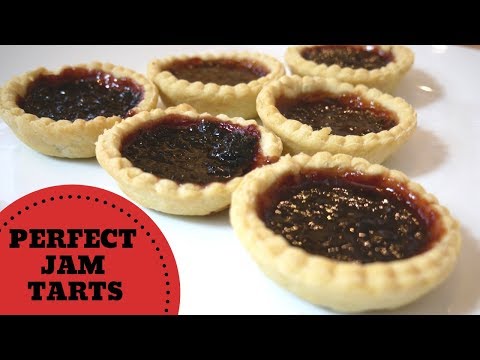
As the tartlets bake, butter melts and steam expands, creating micro-layers that define the short texture. The starches gelatinise, setting the crumb, while sugar caramelises at the surface to deliver colour and mild sweetness. The jam undergoes concentration through evaporation, intensifying its flavour and viscosity. Proper timing ensures the filling thickens without bubbling over, maintaining a clean finish. Once cooled, the pastry firms as residual moisture dissipates, locking in structural integrity. The contrast between crisp shell and glossy jam centre depends on precise control of both bake duration and cooling sequence.
Workflow Efficiency and Component Coordination
Efficient production requires parallel management of dough resting and filling preparation. While the dough chills, portion the jam and prepare tins to streamline assembly. Rolling and cutting should occur swiftly to prevent butter softening. Batch baking on a single preheated baking sheet maximises oven efficiency and ensures consistent results. Cooling on a wire rack prevents condensation accumulation beneath the tartlets. In service environments, tartlets can be baked in advance and refreshed briefly before plating, provided they are stored in airtight containers to preserve crispness.
Regional Technique Lineage
Jam tartlets derive from European shortcrust traditions, particularly British and Italian variants of fruit preserves encased in pastry. The method evolved from larger jam tarts, adapted for portion control and faster service. The use of butter-based pâte sucrée or pâte brisée reflects classical French influence, while the filling’s simplicity aligns with British home baking practices. Regional jams—such as raspberry, apricot, or plum—define local identity within the same structural framework. Modern adaptations maintain the traditional ratio of pastry to preserve while refining texture through controlled fat temperature and precision baking.
Recipe Education
Learn the Skills Behind This Recipe
Build confidence with cooking skills, techniques, and tools used in this recipe.
Baking Tools Guide
Understand essential tools for mixing, measuring, and preparing recipes.
Recommended for the bake method used in this recipe.
Oven Temperature Conversions
Understand oven temperatures and how they affect baking and roasting.
Recommended for the bake method used in this recipe.
Batch Cooking
Cook once and prepare multiple meals more efficiently.
Selected for this type of recipe.


Jam Tartlets
Description
Shortcrust pastry for jam tartlets relies on precise fat dispersion within the flour matrix. Cold butter must remain in discrete particles to inhibit gluten formation, ensuring a crumbly, tender structure rather than elasticity. Water addition should be minimal—just enough to bind the dough without activating excess gluten. The sugar content influences both browning and moisture retention, while a pinch of salt sharpens flavour perception. Resting the dough before rolling allows moisture to equilibrate, reducing shrinkage during baking. The balance between fat and hydration defines the final texture: too much water yields toughness, while insufficient moisture causes cracking during shaping.
Ingredients
Ingredients
Instructions
Instructions
Step 1
Combine plain flour, caster sugar, and salt in a Mixing Bowl. Add cold diced butter and rub with fingertips until the mixture resembles coarse breadcrumbs.Work quickly to prevent butter from warming; temperature control preserves flakiness.Step 2
Add egg yolk and cold water gradually, mixing until the dough just comes together. Do not overwork.Stop mixing as soon as the dough binds; overmixing activates gluten and toughens the pastry.Step 3
Form the dough into a disc, wrap in Cling Film, and refrigerate for 30 minutes to relax the gluten and firm the butter.Chilling ensures even rolling and reduces shrinkage during baking.Step 4
Preheat oven to 180°C. Roll out the chilled dough on a lightly floured surface to 3 mm thickness using a Rolling Pin. Cut rounds to fit a Muffin Pan or Tart Pan.Rotate the dough frequently while rolling to maintain even thickness and prevent sticking.Step 5
Line each cavity with pastry, pressing gently into edges. Spoon approximately 1 teaspoon of jam into each shell, avoiding overfilling.Leave a small margin at the top; jam expands slightly during baking.Step 6
Place the Muffin Pan on a preheated Baking Sheet and bake for 18–20 minutes until pastry edges are golden and jam is set.Preheating the Baking Sheet improves bottom heat transfer, ensuring crisp pastry bases.Step 7
Allow tartlets to cool in the pan for 5 minutes, then transfer to a Cooling Rack to cool completely.Removing too early risks breakage; waiting allows structure to stabilise before handling.
Recommended Equipment

Nutrition Facts
Servings 12
Serving Size 1 portion
- Amount Per Serving
- Calories 201.68kcal
- % Daily Value *
- Total Fat 9.06g14%
- Saturated Fat 5.53g28%
- Cholesterol 38.6mg13%
- Sodium 10.97mg1%
- Potassium 39.26mg2%
- Total Carbohydrate 31.61g11%
- Dietary Fiber 0.75g3%
- Sugars 8.15g
- Protein 2.54g6%
- Vitamin A 281.94 IU
- Vitamin C 1.47 mg
- Calcium 10.97 mg
- Iron 1.09 mg
- Vitamin D 0.24 mcg
- Vitamin E 0.31 mg
- Thiamin 0.17 mg
- Riboflavin 0.13 mg
- Niacin 1.24 mg
- Folate 42.46 mcg
- Pantothenic Acid 0.15 mg
- Phosphorus 34.02 mg
- Magnesium 5.56 mg
- Zinc 0.2 mg
- Selenium 8.34 mcg
- Copper 0.05 mg
- Manganese 0.15 mg
* Nutrition information is provided as an estimate per serving and may vary depending on the ingredients, brands, substitutions, portion sizes and preparation methods used. Percent Daily Values (%DV) are based on U.S. FDA reference values for a 2,000-calorie diet and are intended as a general guide only. Individual nutritional needs vary. This information is not a substitute for advice from a registered dietitian or other qualified healthcare professional.
Note
Allow the dish to cool gradually before sealing. Rapid temperature shifts can create condensation, weakening texture and diluting surface flavour concentration. The resting phase supports structural stabilisation and moisture redistribution. Cutting or serving too early may compromise internal balance. In larger batches, maintain even heat distribution and avoid overcrowding during reheating to preserve structural integrity. Monitor seasoning levels after storage, as salt perception can shift once chilled.


