
Recipe Snapshot
Recipe at a Glance
Key timing, yield and style details before you start cooking.
Fermented Acidity and Protein Structure
Kimchi introduces lactic acid and residual fermentation gases that interact with egg proteins during coagulation. The acidity slightly denatures albumin before heat application, producing a more tender curd. The salt and chili compounds from kimchi also influence osmotic balance, drawing limited moisture from the eggs and concentrating flavour. Balancing hydration is critical: excess kimchi juice can thin the egg matrix, delaying set and causing surface weeping. Controlled draining and fine chopping ensure even distribution without localized acidity pockets that would toughen the protein network.
Heat Regulation and Moisture Retention
The omelette requires medium heat to achieve uniform coagulation without over-browning. Excessive surface temperature causes rapid protein contraction, forcing out moisture and creating a rubbery texture. A non-stick skillet or well-seasoned pan stabilizes heat transfer and minimizes sticking. The inclusion of oil with a moderate smoke point ensures consistent lubrication and prevents localized scorching. Timing is critical: the eggs must be set but still glossy before folding, allowing residual heat to complete the cook through carryover without further direct exposure.
Textural and Flavour Transformation
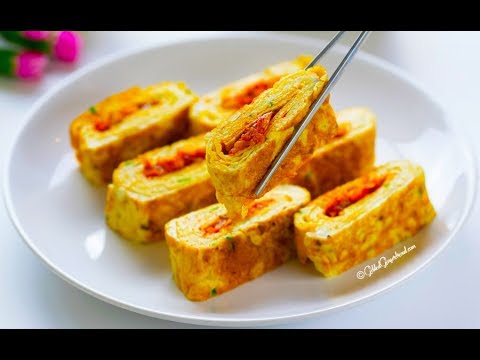
Cooking transforms the raw sharpness of kimchi into a mellow, integrated savouriness. The Maillard reaction on the pan surface develops subtle caramel notes that balance the fermented acidity. The softened kimchi provides chew and contrast against the custard-like egg body. The inclusion of scallions or sesame oil enhances aromatic depth while maintaining structural lightness. The final texture should be cohesive yet layered—moist interior, lightly browned exterior, and evenly distributed inclusions that maintain bite integrity without tearing the omelette matrix.
Workflow Efficiency and Preparation Logic
Efficient mise en place prevents overcooking. Pre-chopping kimchi, pre-beating eggs, and pre-heating the pan ensure continuous workflow. The sequence—aromatics first, then kimchi, then eggs—avoids temperature drops that would inhibit proper set. Parallel preparation of garnish or side elements during resting maximizes service efficiency. Avoid overmixing eggs, as excessive aeration produces uneven curd formation and weakens folding stability. Controlled staging and minimal utensil transitions maintain consistency across multiple portions in a professional environment.
Cultural Context and Technique Lineage
The kimchi omelette represents a modern adaptation of Korean banchan integration into Western egg cookery. Traditional Korean cuisine often combines fermented vegetables with eggs in jeon or gyeran dishes, emphasizing balance between acidity and richness. The omelette form borrows from French technique, merging precise heat control with Korean fermentation flavour. This hybrid reflects the evolution of cross-cultural breakfast and lunch formats, where fermentation-driven umami is applied to classical folded-egg structures for efficiency and flavour depth.
Recipe Education
Learn the Skills Behind This Recipe
Build confidence with cooking skills, techniques, and tools used in this recipe.
How to Fry Properly
Understand pan heat, oil temperature, and how to get better frying results.
Recommended for the fry method used in this recipe.
How to Sauté Properly
Master fast cooking, pan heat, and ingredient timing for better texture.
Recommended for the saute method used in this recipe.
Teaspoons to Grams
Use small-measure conversions more accurately in cooking and baking.
Helpful when using measuring spoons during preparation.
Baking Tools Guide
Understand essential tools for mixing, measuring, and preparing recipes.
Helpful when using mixing bowl during preparation.
Cooking Basics
Build safer knife preparation, heat control, timing, and everyday kitchen confidence.
Helpful when using chef knife during preparation.


Kimchi Omelette
Description
Kimchi introduces lactic acid and residual fermentation gases that interact with egg proteins during coagulation. The acidity slightly denatures albumin before heat application, producing a more tender curd. The salt and chili compounds from kimchi also influence osmotic balance, drawing limited moisture from the eggs and concentrating flavour. Balancing hydration is critical: excess kimchi juice can thin the egg matrix, delaying set and causing surface weeping. Controlled draining and fine chopping ensure even distribution without localized acidity pockets that would toughen the protein network.
Ingredients
Ingredients
Instructions
Instructions
Step 1
Crack the eggs into a Mixing Bowl, add milk, salt, and black pepper, and whisk until homogeneous but not frothy.Avoid over-whisking; minimal aeration ensures a dense, custard-like texture rather than a spongy one.Step 2
Heat the Non-stick Skillet over medium heat and add vegetable oil. When the surface shimmers, add chopped kimchi and sauté for 1–2 minutes until aromatic and slightly caramelized.Allow moisture from kimchi to evaporate before adding eggs to prevent steaming and dilution of the curd.Step 3
Pour the beaten egg mixture evenly over the kimchi. Tilt the pan to distribute and reduce heat to medium-low.Lowering heat after pouring stabilizes coagulation and prevents the underside from over-browning before the top sets.Step 4
Sprinkle sliced scallions evenly over the surface and cook until the edges begin to firm while the center remains slightly fluid.Use a Silicone Spatula to gently lift edges and allow uncooked egg to flow underneath for even setting.Step 5
Drizzle sesame oil over the surface, fold the omelette in half, and cook for an additional 30 seconds to seal. Remove from heat and rest for 1 minute before serving.Carryover heat will complete the set; removing early preserves moisture and prevents a dry interior.
Recommended Equipment

Nutrition Facts
Servings 1
Serving Size 1 portion
- Amount Per Serving
- Calories 308.24kcal
- % Daily Value *
- Total Fat 24.43g38%
- Saturated Fat 6.13g31%
- Cholesterol 492.9mg165%
- Sodium 532.5mg23%
- Potassium 324.89mg10%
- Total Carbohydrate 3.91g2%
- Dietary Fiber 1.25g5%
- Sugars 2.1g
- Protein 17.98g36%
- Vitamin A 893.91 IU
- Vitamin C 1.88 mg
- Calcium 120.42 mg
- Iron 3.97 mg
- Vitamin D 2.81 mcg
- Vitamin E 2.29 mg
- Vitamin K 64.66 mcg
- Thiamin 0.07 mg
- Riboflavin 0.76 mg
- Niacin 0.83 mg
- Vitamin B6 0.37 mg
- Folate 99.66 mcg
- Vitamin B12 1.26 mcg
- Pantothenic Acid 2.09 mg
- Phosphorus 295.24 mg
- Magnesium 28.27 mg
- Zinc 1.94 mg
- Selenium 41.18 mcg
- Copper 0.12 mg
- Manganese 0.07 mg
* Nutrition information is provided as an estimate per serving and may vary depending on the ingredients, brands, substitutions, portion sizes and preparation methods used. Percent Daily Values (%DV) are based on U.S. FDA reference values for a 2,000-calorie diet and are intended as a general guide only. Individual nutritional needs vary. This information is not a substitute for advice from a registered dietitian or other qualified healthcare professional.
Note
Store in an airtight container under refrigeration, ensuring minimal air exposure to preserve flavour integrity and textural balance. The resting phase supports structural stabilisation and moisture redistribution. Cutting or serving too early may compromise internal balance. Dairy-based elements may thicken further upon cooling. Reheat gently to prevent separation or grainy texture. Monitor seasoning levels after storage, as salt perception can shift once chilled.


