
Recipe Snapshot
Recipe at a Glance
Key timing, yield and style details before you start cooking.
Ingredient Hydration and Structural Balance
The dumpling filling in Mandu Guk depends on balanced moisture retention between minced pork, tofu, and vegetables. Tofu must be pressed to remove excess water, preventing soggy wrappers during simmering. Egg acts as a binder, stabilising the protein matrix and reducing filling separation. The broth’s sodium and umami levels are controlled through soy sauce and anchovy stock, ensuring depth without overpowering the dumplings. Rice cake slices introduce starch density, which slightly thickens the broth as gelatinised starch disperses. Proper hydration of rice cakes before cooking prevents uneven texture and excessive absorption of broth, maintaining clarity and viscosity control throughout the simmering phase.
Heat Management and Simmering Control
Temperature staging is critical to maintain dumpling integrity. The broth should reach a gentle simmer before dumplings are introduced to prevent wrapper rupture from turbulent boiling. Carryover heat continues to cook the filling after removal from direct heat, so overcooking risks a dense texture. Rice cakes are added midway through simmering to synchronise their softening with dumpling readiness. Evaporation must be controlled to preserve broth concentration; excessive reduction alters salt balance. Maintaining a consistent medium heat ensures even cooking and prevents protein scum from clouding the broth, preserving a clean, translucent finish.
Transformation Through Cooking
During simmering, the dumpling filling undergoes protein denaturation, firming the structure while retaining internal moisture. The rice cakes gelatinise, developing a chewy elasticity that contrasts with the tender dumplings. The broth absorbs rendered fat and aromatic compounds from the filling, deepening flavour complexity. Egg ribbons added at the end set instantly in the hot broth, introducing a delicate layer of texture and visual contrast. The transformation phase relies on precise timing—too long and the dumplings lose definition; too short and the filling remains undercooked. Controlled simmering achieves a cohesive, balanced mouthfeel.
Workflow Efficiency and Mise en Place Logic
Efficient preparation requires staging components by cooking time. Dumplings can be preassembled and frozen, allowing direct cooking from frozen without thawing. Broth preparation should precede all other steps to maintain service readiness. Rice cakes are soaked while the broth heats, aligning hydration with cooking sequence. Garnishes such as sliced spring onions and egg ribbons should be prepped last to preserve colour and freshness. Parallelisation between broth reduction and dumpling assembly reduces idle time. Maintaining a clean station prevents cross-contamination between raw filling and cooked components, critical for service consistency.
Cultural and Regional Context
Mandu Guk originates from Korean New Year traditions, where dumplings symbolise wealth and renewal. The dish evolved from northern Korean mandu-making practices influenced by Chinese jiaozi, adapted to local broth-based serving customs. Regional variations exist: some use beef broth instead of anchovy stock, while others incorporate kimchi mandu for acidity. The inclusion of tteok (rice cakes) aligns it with tteokguk, merging two celebratory dishes into one. Modern adaptations maintain traditional structure but streamline preparation through pre-made mandu and clarified stock bases, preserving cultural authenticity while meeting contemporary kitchen efficiency.
Recipe Education
Learn the Skills Behind This Recipe
Build confidence with cooking skills, techniques, and tools used in this recipe.
How to Boil Properly
Learn boiling times, temperature control, and how to avoid overcooking.
Recommended for the boil method used in this recipe.
Simmer vs Boil
Learn when to simmer, when to boil, and how each affects recipe results.
Recommended for the simmer method used in this recipe.
Cookware Guide
Learn which pots and pans work best for frying, sautéing, simmering, and roasting.
Helpful when using saucepan during preparation.
Baking Tools Guide
Understand essential tools for mixing, measuring, and preparing recipes.
Helpful when using mixing bowl during preparation.
Cooking Basics
Build safer knife preparation, heat control, timing, and everyday kitchen confidence.
Helpful when using chef knife during preparation.


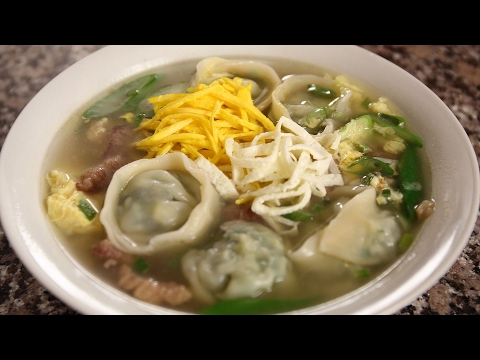
Mandu Guk (Dumpling Soup)
Description
The dumpling filling in Mandu Guk depends on balanced moisture retention between minced pork, tofu, and vegetables. Tofu must be pressed to remove excess water, preventing soggy wrappers during simmering. Egg acts as a binder, stabilising the protein matrix and reducing filling separation. The broth’s sodium and umami levels are controlled through soy sauce and anchovy stock, ensuring depth without overpowering the dumplings. Rice cake slices introduce starch density, which slightly thickens the broth as gelatinised starch disperses. Proper hydration of rice cakes before cooking prevents uneven texture and excessive absorption of broth, maintaining clarity and viscosity control throughout the simmering phase.
Ingredients
Ingredients
Instructions
Instructions
Step 1
Soak the sliced rice cakes in cold water for 20 minutes to soften. Drain thoroughly before cooking.Ensure rice cakes are fully submerged during soaking to achieve uniform hydration and prevent uneven softening.Step 2
In a Stock Pot, bring anchovy stock to a gentle simmer over medium heat. Skim any foam that rises to maintain clarity.Use a Spider / Skimmer to remove surface scum early; this prevents cloudiness and off-flavours in the final broth.Step 3
Add minced garlic, soy sauce, and sesame oil to the simmering stock. Stir with a Wooden Spoon to distribute seasoning evenly.Introduce aromatics before dumplings to allow flavour infusion without overcooking delicate wrappers.Step 4
Add the soaked rice cakes and simmer for 5 minutes until slightly translucent. Then add mandu and cook for 6–8 minutes until dumplings float and are fully heated through.Avoid vigorous boiling; maintain a steady simmer to prevent dumpling rupture and broth clouding.Step 5
Slowly drizzle the beaten egg into the hot broth while stirring gently to form thin ribbons. Season with salt and black pepper.Pour the egg in a thin stream from height to create fine strands rather than clumps.Step 6
Ladle the soup into bowls and garnish with sliced spring onion. Serve immediately while hot.Add garnish only at plating to preserve colour contrast and prevent chlorophyll dulling from residual heat.
Recommended Equipment

Nutrition Facts
Servings 2
Serving Size 1 portion
- Amount Per Serving
- Calories 1006.78kcal
- % Daily Value *
- Total Fat 30.68g48%
- Saturated Fat 7.85g40%
- Cholesterol 381.84mg128%
- Sodium 1365.43mg57%
- Potassium 2207.9mg64%
- Total Carbohydrate 62.88g21%
- Dietary Fiber 3.47g14%
- Sugars 1.05g
- Protein 111.85g224%
- Vitamin A 430.12 IU
- Vitamin C 1.6 mg
- Calcium 765.69 mg
- Iron 18.11 mg
- Vitamin D 0.44 mcg
- Vitamin E 4.08 mg
- Vitamin K 15.15 mcg
- Thiamin 0.34 mg
- Riboflavin 1.52 mg
- Niacin 76.39 mg
- Vitamin B6 0.91 mg
- Folate 76.64 mcg
- Vitamin B12 3.3 mcg
- Pantothenic Acid 4.36 mg
- Phosphorus 1200.17 mg
- Magnesium 311.5 mg
- Zinc 11.22 mg
- Selenium 208.04 mcg
- Copper 1.43 mg
- Manganese 3.27 mg
* Nutrition information is provided as an estimate per serving and may vary depending on the ingredients, brands, substitutions, portion sizes and preparation methods used. Percent Daily Values (%DV) are based on U.S. FDA reference values for a 2,000-calorie diet and are intended as a general guide only. Individual nutritional needs vary. This information is not a substitute for advice from a registered dietitian or other qualified healthcare professional.
Note
Allow the dish to cool gradually before sealing. Rapid temperature shifts can create condensation, weakening texture and diluting surface flavour concentration. Grains and starches continue absorbing moisture after cooking. Adjust liquid slightly when reheating to restore optimal consistency. Slow-cooked preparations often improve after several hours or overnight refrigeration as aromatic compounds integrate more fully. Monitor seasoning levels after storage, as salt perception can shift once chilled.


