
Recipe Snapshot
Recipe at a Glance
Key timing, yield and style details before you start cooking.
Acid-Sugar Balance and Herb Volatility
Mint sauce relies on a controlled acid-sugar equilibrium to stabilise chlorophyll brightness while moderating sharpness. Vinegar provides the acid phase, which must be balanced with sugar to prevent excessive astringency. The sugar also binds free acids, softening the perception of sourness without dulling the herb’s aromatic oils. Fresh mint leaves contain volatile compounds that degrade rapidly under heat; therefore, hydration and chopping sequence are critical. Finely chopping after washing and drying ensures minimal bruising and oxidation. The ratio of liquid to herb mass determines viscosity—too much liquid dilutes flavour, while too little prevents proper infusion and dispersion.
Temperature Control and Infusion Management
The infusion stage defines flavour extraction efficiency. Boiling vinegar directly over mint would destroy aromatic compounds, so the liquid is heated separately before contact. Pouring hot vinegar over chopped mint initiates controlled steeping, releasing essential oils without prolonged thermal exposure. The temperature should be just below boiling to avoid chlorophyll degradation. Stirring during cooling ensures even distribution of dissolved sugar and acid. The sauce must cool uncovered initially to allow volatile vapours to dissipate, then covered to prevent oxidation. Timing precision between heating and steeping determines the final aromatic intensity and colour retention.
Transformation Through Steeping and Maturation
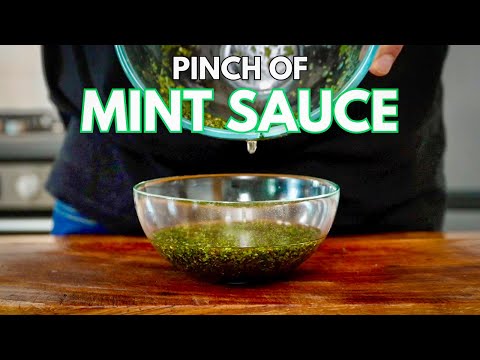
During steeping, the mint’s cell walls soften, releasing flavour compounds into the acidic medium. The sugar dissolves completely, creating a balanced syrup that carries both sweetness and acidity. As the sauce cools, the infusion stabilises, and the liquid thickens slightly through natural pectin traces in the leaves. Resting time allows the flavours to integrate and the harshness of vinegar to mellow. The transformation is chemical rather than thermal—acid diffusion and aromatic binding occur gradually. Proper maturation yields a bright green, aromatic sauce with a clean finish and stable suspension of fine mint particles.
Workflow Efficiency and Storage Stability
Efficient mise en place ensures rapid assembly: mint chopped, sugar measured, vinegar preheated. The process is linear and short, but precision in timing avoids flavour loss. Cooling and storage are critical; the sauce should be transferred to sterilised containers once cooled to room temperature. Acidic pH naturally inhibits microbial growth, extending shelf life. For service, small batches should be refreshed with additional mint if stored beyond several days. Avoid metal containers, as acid can react and alter flavour. The workflow supports both batch production and à la minute preparation without compromising consistency.
Cultural and Regional Context
Mint sauce is a traditional British condiment, historically paired with roasted lamb to offset fat richness through acidity and herbal freshness. Its origin lies in vinegar-based herb sauces used since medieval times, evolving into a mint-specific variant due to local herb availability and preservation needs. The technique reflects a broader European practice of acidifying herbs for storage before refrigeration. Modern adaptations maintain the same structural logic but refine sugar ratios and steeping control for cleaner flavour. The sauce remains a defining element of British roast service, balancing heavy proteins with sharp aromatic contrast.
Recipe Education
Learn the Skills Behind This Recipe
Build confidence with cooking skills, techniques, and tools used in this recipe.
Cooking Basics
Build safer knife preparation, heat control, timing, and everyday kitchen confidence.
Helpful when using chef knife during preparation.
Simmer vs Boil
Learn when to simmer, when to boil, and how each affects recipe results.
Recommended for the simmer method used in this recipe.
Cookware Guide
Learn which pots and pans work best for frying, sautéing, simmering, and roasting.
Helpful when using saucepan during preparation.
Baking Tools Guide
Understand essential tools for mixing, measuring, and preparing recipes.
Helpful when using mixing bowl during preparation.
Batch Cooking
Cook once and prepare multiple meals more efficiently.
Selected for this type of recipe.


Mint Sauce
Description
Mint sauce relies on a controlled acid-sugar equilibrium to stabilise chlorophyll brightness while moderating sharpness. Vinegar provides the acid phase, which must be balanced with sugar to prevent excessive astringency. The sugar also binds free acids, softening the perception of sourness without dulling the herb’s aromatic oils. Fresh mint leaves contain volatile compounds that degrade rapidly under heat; therefore, hydration and chopping sequence are critical. Finely chopping after washing and drying ensures minimal bruising and oxidation. The ratio of liquid to herb mass determines viscosity—too much liquid dilutes flavour, while too little prevents proper infusion and dispersion.
Ingredients
Ingredients
Instructions
Instructions
Step 1
Wash and dry the fresh mint leaves thoroughly using a Colander / Strainer, then finely chop them on a Cutting Board with a Chef Knife.Ensure the leaves are completely dry before chopping to prevent premature oxidation and darkening.Step 2
In a Saucepan, combine malt vinegar and caster sugar. Heat gently over medium heat until the sugar dissolves completely, without allowing the mixture to boil.Keep the liquid below 95°C to preserve vinegar volatility and prevent caramelisation of the sugar.Step 3
Place the chopped mint into a Mixing Bowl and sprinkle with fine salt. Pour the hot vinegar mixture over the mint and stir gently with a Silicone Spatula.Stirring evenly ensures uniform steeping and prevents the mint from clumping at the surface.Step 4
Allow the mixture to stand uncovered for 10 minutes to release excess vapours, then cover and let it cool to room temperature.Partial cooling uncovered prevents condensation, which can dilute the sauce and reduce aromatic intensity.Step 5
Adjust consistency with hot water if required, then transfer to sterilised Mason Jars for storage or immediate service.Add water incrementally; excessive dilution will flatten acidity and reduce flavour concentration.
Recommended Equipment

Nutrition Facts
Servings 6
Serving Size 1 portion
- Amount Per Serving
- Calories 9.71kcal
- % Daily Value *
- Total Fat 0.08g1%
- Saturated Fat 0.02g1%
- Sodium 9.72mg1%
- Potassium 47.85mg2%
- Total Carbohydrate 5.42g2%
- Dietary Fiber 0.67g3%
- Sugars 0.01g
- Protein 0.31g1%
- Vitamin A 354 IU
- Vitamin C 2.65 mg
- Calcium 21.7 mg
- Iron 0.43 mg
- Riboflavin 0.02 mg
- Folate 9.5 mcg
- Magnesium 6.93 mg
- Copper 0.03 mg
- Manganese 0.11 mg
* Nutrition information is provided as an estimate per serving and may vary depending on the ingredients, brands, substitutions, portion sizes and preparation methods used. Percent Daily Values (%DV) are based on U.S. FDA reference values for a 2,000-calorie diet and are intended as a general guide only. Individual nutritional needs vary. This information is not a substitute for advice from a registered dietitian or other qualified healthcare professional.
Note
Store in an airtight container under refrigeration, ensuring minimal air exposure to preserve flavour integrity and textural balance. The resting phase supports structural stabilisation and moisture redistribution. Cutting or serving too early may compromise internal balance. In larger batches, maintain even heat distribution and avoid overcrowding during reheating to preserve structural integrity. Monitor seasoning levels after storage, as salt perception can shift once chilled.


