
Recipe Snapshot
Recipe at a Glance
Key timing, yield and style details before you start cooking.
Ingredient Interaction and Structural Balance
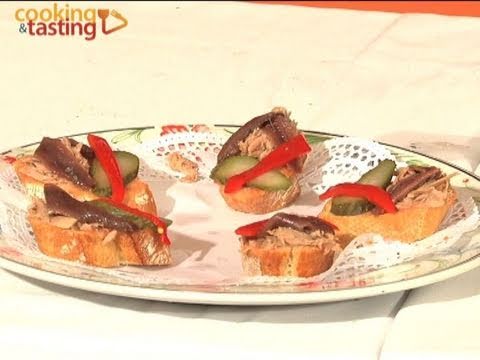
The montadito relies on controlled moisture balance between the toasted bread base, the oil-packed tuna, and the roasted piquillo peppers. The bread must be crisp enough to resist saturation yet porous enough to absorb a thin layer of olive oil for flavour cohesion. The tuna’s natural salinity and oil content integrate with the mild sweetness and acidity of the peppers, forming a balanced fat-acid interface. A small amount of salt heightens the umami from the tuna, while the olive oil acts as a carrier for aromatic compounds released from the peppers. The layering sequence—bread, oil, pepper, tuna—ensures structural integrity and prevents sogginess during service.
Heat and Moisture Management During Preparation
The only active heat phase is the controlled toasting of the bread. The objective is to achieve a dry, golden crust without over-dehydrating the crumb. Using a medium-high heat on a Grill Pan or Toaster Oven allows even browning and moisture evaporation without burning. The peppers, typically pre-roasted, must be drained and patted dry to prevent residual liquid from compromising the bread texture. The tuna should remain at room temperature before assembly to avoid condensation that could soften the base. Timing precision between toasting and assembly is critical to maintain optimal temperature contrast and textural definition.
Transformation Through Assembly and Flavour Integration
Although minimal cooking occurs, the transformation lies in the integration of textures and flavours. The toasted bread provides a crisp matrix that contrasts with the tender pepper and flaky tuna. Olive oil applied post-toasting undergoes mild thermal absorption, releasing volatile aromatic compounds that enhance the overall profile. The final drizzle of oil and optional garnish of chopped parsley or sea salt flakes introduces a final sensory layer. The resting period of one to two minutes before service allows oil migration and flavour cohesion without structural collapse, ensuring each bite maintains defined layers.
Workflow Efficiency and Service Coordination
In professional service, montaditos are assembled à la minute to preserve crispness. Bread slices can be pre-toasted and held briefly on a Cooling Rack to prevent steam accumulation. Peppers and tuna should be portioned in advance for rapid assembly. Using a Silicone Spatula for oil application ensures even coverage without oversaturation. The mise en place must separate wet and dry components to avoid cross-contamination of textures. For batch service, stagger toasting cycles to maintain consistent temperature and avoid holding finished montaditos under heat, which would degrade the bread structure.
Regional and Cultural Context
Montaditos originate from Andalusian and Basque tapas traditions, where small open-faced sandwiches serve as quick, flavour-dense bites. The combination of tuna and piquillo peppers reflects Spanish pantry staples—preserved seafood and roasted peppers—developed through preservation techniques suited to Mediterranean climates. The dish exemplifies the Spanish approach to balance between preserved and fresh elements, using olive oil as both flavour enhancer and preservation medium. Modern adaptations maintain the same structural logic while refining presentation and portion control for contemporary tapas service.
Recipe Education
Learn the Skills Behind This Recipe
Build confidence with cooking skills, techniques, and tools used in this recipe.
Cooking Basics
Build safer knife preparation, heat control, timing, and everyday kitchen confidence.
Helpful when using chef knife during preparation.
How to Substitute Ingredients
Swap ingredients more safely without damaging flavour, texture, or structure.
Helpful cooking knowledge for recipes like this.
Cookware Guide
Learn which pots and pans work best for frying, sautéing, simmering, and roasting.
Helpful cooking knowledge for recipes like this.


Montadito de Atún y Piquillo
Description
The montadito relies on controlled moisture balance between the toasted bread base, the oil-packed tuna, and the roasted piquillo peppers. The bread must be crisp enough to resist saturation yet porous enough to absorb a thin layer of olive oil for flavour cohesion. The tuna’s natural salinity and oil content integrate with the mild sweetness and acidity of the peppers, forming a balanced fat-acid interface. A small amount of salt heightens the umami from the tuna, while the olive oil acts as a carrier for aromatic compounds released from the peppers. The layering sequence—bread, oil, pepper, tuna—ensures structural integrity and prevents sogginess during service.
Ingredients
Ingredients
Instructions
Instructions
Step 1
Preheat a Grill Pan over medium-high heat. Place baguette slices on the hot surface and toast each side for 1–2 minutes until golden and crisp.Rotate slices halfway through toasting to ensure even browning and prevent localized scorching.Step 2
Transfer toasted slices to a Cooling Rack to release residual steam. Brush each slice lightly with extra virgin olive oil using a Silicone Spatula.Apply oil while bread is still warm to promote partial absorption without softening the crust.Step 3
Lay one piquillo pepper piece on each slice, pressing gently to flatten and cover the surface evenly.Pat peppers dry with a Tea Towel before assembly to prevent moisture bleed into the bread.Step 4
Top each pepper layer with a portion of drained tuna, distributing flakes evenly to maintain balance across the surface.Avoid compacting the tuna; keeping it loose preserves texture contrast and visual volume.Step 5
Drizzle a few drops of olive oil over each montadito, sprinkle with sea salt flakes, and garnish with chopped parsley if using. Rest for 1–2 minutes before serving.Allowing a brief rest enables oil migration and flavour integration without compromising crispness.
Recommended Equipment

Nutrition Facts
Servings 4
Serving Size 1 portion
- Amount Per Serving
- Calories 153.46kcal
- % Daily Value *
- Total Fat 5.95g10%
- Saturated Fat 0.95g5%
- Cholesterol 3.6mg2%
- Sodium 865.68mg37%
- Potassium 86.5mg3%
- Total Carbohydrate 15.53g6%
- Dietary Fiber 0.7g3%
- Sugars 1.53g
- Protein 8.89g18%
- Vitamin A 105.43 IU
- Vitamin C 1.86 mg
- Calcium 37.9 mg
- Iron 1.48 mg
- Vitamin D 1.34 mcg
- Vitamin E 0.77 mg
- Vitamin K 27.4 mcg
- Thiamin 0.19 mg
- Riboflavin 0.13 mg
- Niacin 3.95 mg
- Vitamin B6 0.06 mg
- Folate 36.68 mcg
- Vitamin B12 0.44 mcg
- Pantothenic Acid 0.2 mg
- Phosphorus 93.15 mg
- Magnesium 15.01 mg
- Zinc 0.44 mg
- Selenium 20.71 mcg
- Copper 0.05 mg
- Manganese 0.15 mg
* Nutrition information is provided as an estimate per serving and may vary depending on the ingredients, brands, substitutions, portion sizes and preparation methods used. Percent Daily Values (%DV) are based on U.S. FDA reference values for a 2,000-calorie diet and are intended as a general guide only. Individual nutritional needs vary. This information is not a substitute for advice from a registered dietitian or other qualified healthcare professional.
Note
For best structural retention, cool uncovered briefly before storage to prevent trapped steam from softening exterior crust or caramelised surfaces. The resting phase supports structural stabilisation and moisture redistribution. Cutting or serving too early may compromise internal balance. Spice intensity can deepen over time as volatile compounds settle. Taste and adjust seasoning after resting. When reheating crisp components, use dry heat rather than microwave methods to maintain exterior texture. Acid balance may soften slightly over time; a final adjustment before serving restores clarity.


