
Recipe Snapshot
Recipe at a Glance
Key timing, yield and style details before you start cooking.
Hydration and Starch Gelatinisation Control
Mochi structure depends on the hydration ratio between glutinous rice flour and water. The starch granules in glutinous rice flour gelatinise fully only when sufficient moisture and heat are applied simultaneously. Too little water yields a dense, rubbery texture; too much creates a sticky mass that fails to hold shape. Sugar not only sweetens but also interferes with retrogradation, delaying hardening. The red bean paste introduces additional moisture and protein, which must be balanced by slightly reducing water in the dough to prevent surface weeping. Salt enhances the perception of sweetness and stabilises the starch gel network by moderating ionic interactions during steaming.
Heat Management and Steaming Precision
Steaming is the preferred method for mochi dough because it provides uniform heat transfer without direct surface dehydration. Maintaining consistent steam intensity ensures even gelatinisation across the dough mass. Oversteaming can cause excessive condensation, leading to surface stickiness and structural collapse. Understeaming leaves raw starch pockets that resist kneading. The dough must be kneaded while still hot to align starch polymers and develop elasticity. Temperature staging is critical: kneading below 60°C results in incomplete elasticity, while above 80°C risks burns and over-softening. Controlled cooling before shaping prevents condensation from softening the outer layer.
Textural Transformation and Filling Integration
Once steamed, the mochi dough transitions from opaque to translucent, indicating full gelatinisation. Kneading redistributes moisture and creates a cohesive, elastic matrix capable of stretching around the red bean filling. The filling must be firm and cool to prevent melting the dough from within. Dusting with starch isolates the surface, preventing adhesion during shaping. The final texture should be soft, slightly chewy, and resilient without tearing. Proper sealing around the filling ensures moisture retention and prevents leakage during storage. The balance between dough thickness and filling density defines the final mouthfeel and structural integrity.
Workflow Efficiency and Handling Discipline
Mochi assembly requires strict mise en place to avoid temperature loss and sticking. The dough should be portioned immediately after kneading while still pliable. Cornstarch or potato starch must be pre-sifted and spread on the work surface before handling. Working in small batches prevents the dough from cooling excessively, which would increase resistance and risk tearing. Using a silicone spatula instead of hands during initial handling reduces heat transfer and sticking. The red bean paste should be pre-portioned and chilled to maintain firmness during wrapping. Efficient sequencing ensures consistent product texture across all units.
Regional Technique Lineage and Adaptation
Anko mochi originates from Japanese wagashi traditions, where glutinous rice was pounded into paste and combined with sweetened red bean filling. The modern version using shiratamako or mochiko flour evolved for efficiency and consistency in small-scale kitchens. Regional variations exist: Kansai-style mochi tends to be softer and sweeter, while Kanto versions are firmer for longer shelf stability. The use of steaming rather than pounding reflects adaptation to urban kitchens lacking traditional usu and kine tools. The dish remains a core representation of Japanese starch-based confectionery, balancing texture precision with ingredient purity.
Recipe Education
Learn the Skills Behind This Recipe
Build confidence with cooking skills, techniques, and tools used in this recipe.
Cooking Basics
Build safer knife preparation, heat control, timing, and everyday kitchen confidence.
Helpful when using chef knife during preparation.
Baking Tools Guide
Understand essential tools for mixing, measuring, and preparing recipes.
Helpful when using mixing bowl during preparation.
How to Substitute Ingredients
Swap ingredients more safely without damaging flavour, texture, or structure.
Helpful cooking knowledge for recipes like this.


Red Bean Mochi (Anko Mochi)
Description
Mochi structure depends on the hydration ratio between glutinous rice flour and water. The starch granules in glutinous rice flour gelatinise fully only when sufficient moisture and heat are applied simultaneously. Too little water yields a dense, rubbery texture; too much creates a sticky mass that fails to hold shape. Sugar not only sweetens but also interferes with retrogradation, delaying hardening. The red bean paste introduces additional moisture and protein, which must be balanced by slightly reducing water in the dough to prevent surface weeping. Salt enhances the perception of sweetness and stabilises the starch gel network by moderating ionic interactions during steaming.
Ingredients
Ingredients
Instructions
Instructions
Step 1
Combine glutinous rice flour, sugar, and salt in a Mixing Bowl. Gradually add water while stirring with a Silicone Spatula until a smooth batter forms with no lumps.Add water incrementally to control viscosity; the batter should flow slowly off the spatula without separating.Step 2
Transfer the mixture into a heatproof bowl and place it in a Steamer Basket over boiling water. Steam for 15–20 minutes until the dough turns translucent and cohesive.Maintain steady steam output; inconsistent steam pressure causes uneven gelatinisation and patchy texture.Step 3
Remove the bowl from the steamer and knead the hot dough using a Silicone Spatula until elastic and glossy. Allow it to cool slightly until comfortable to handle.Knead while the dough is above 60°C to align starch chains; delayed kneading reduces elasticity.Step 4
Dust a Cutting Board with potato starch. Transfer the mochi dough onto it and flatten to about 1 cm thickness. Cut into 8 equal pieces using a Chef Knife dusted with starch.Keep the knife lightly coated with starch to prevent drag and tearing during portioning.Step 5
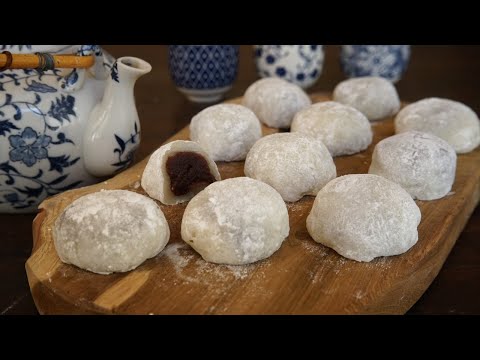
Flatten each mochi piece into a disc, place a portion of red bean paste in the center, and wrap by pinching edges together to seal. Shape into smooth balls.Work quickly; as the dough cools, its extensibility decreases, increasing risk of cracking.Step 6
Lightly dust finished mochi with additional potato starch to prevent sticking. Allow to rest at room temperature for 15 minutes before serving or storing.Resting equalises internal moisture, stabilising surface tackiness and improving chew consistency.
Recommended Equipment

Nutrition Facts
Servings 8
Serving Size 1 portion
- Amount Per Serving
- Calories 169.97kcal
- % Daily Value *
- Total Fat 0.13g1%
- Saturated Fat 0.02g1%
- Sodium 9.39mg1%
- Potassium 52.08mg2%
- Total Carbohydrate 38.94g13%
- Dietary Fiber 1.47g6%
- Sugars 17.01g
- Protein 2.75g6%
- Calcium 10.08 mg
- Iron 0.7 mg
- Thiamin 0.04 mg
- Niacin 0.53 mg
- Vitamin B6 0.05 mg
- Pantothenic Acid 0.17 mg
- Phosphorus 19.61 mg
- Magnesium 6.98 mg
- Zinc 0.25 mg
- Selenium 2.9 mcg
- Copper 0.04 mg
- Manganese 0.19 mg
* Nutrition information is provided as an estimate per serving and may vary depending on the ingredients, brands, substitutions, portion sizes and preparation methods used. Percent Daily Values (%DV) are based on U.S. FDA reference values for a 2,000-calorie diet and are intended as a general guide only. Individual nutritional needs vary. This information is not a substitute for advice from a registered dietitian or other qualified healthcare professional.
Note
Store in an airtight container under refrigeration, ensuring minimal air exposure to preserve flavour integrity and textural balance. The resting phase supports structural stabilisation and moisture redistribution. Cutting or serving too early may compromise internal balance. Grains and starches continue absorbing moisture after cooking. Adjust liquid slightly when reheating to restore optimal consistency. In larger batches, maintain even heat distribution and avoid overcrowding during reheating to preserve structural integrity. Acid balance may soften slightly over time; a final adjustment before serving restores clarity.


