
Recipe Snapshot
Recipe at a Glance
Key timing, yield and style details before you start cooking.
Hydration and Starch Behaviour in Sweet Trahanas
Trahanas relies on controlled starch hydration to achieve its characteristic creamy consistency. The dried fermented wheat granules absorb liquid progressively, requiring gradual addition of milk to prevent clumping and uneven gelatinisation. The milk’s fat content moderates starch swelling and contributes to a smooth mouthfeel, while the natural acidity of trahanas balances sweetness from honey. Salt must be minimal to avoid suppressing the delicate dairy and cereal notes. Proper sequencing—adding trahanas to warm, not boiling, milk—ensures even dispersion and prevents surface gelatinisation that can trap dry cores within the granules.
Thermal Regulation and Evaporation Control
Maintaining medium-low heat during cooking is critical to prevent scorching of milk solids and to allow uniform hydration of trahanas. Excessive heat leads to rapid evaporation and uneven thickening, while insufficient heat delays starch activation. Constant stirring with a Silicone Spatula ensures even heat distribution and prevents sedimentation at the base of the Saucepan. The goal is a gentle simmer, not a rolling boil, to stabilise the emulsion between milk fat and starch. Once the mixture thickens, residual heat continues to cook the granules, so removal from direct heat slightly before full thickness is achieved prevents over-setting.
Textural Transformation and Flavour Integration
As trahanas hydrates, starch granules swell and release amylose, creating a cohesive matrix that traps milk fat and honey. This transformation yields a porridge-like texture with mild tang from fermentation balanced by sweetness. The honey should be incorporated off heat to preserve volatile floral compounds and prevent caramelisation. Butter, if used, adds gloss and enhances mouth-coating richness. The final texture should be thick yet pourable, with visible grain definition but no dry particles. Overcooking leads to gummy density, while undercooking leaves a gritty texture from incomplete starch gelatinisation.
Workflow Efficiency and Service Timing
Efficient mise en place is essential: measure trahanas, milk, and honey before heating begins. The cooking window is narrow—approximately 10 minutes—so uninterrupted stirring is required. Using a heavy-bottomed Saucepan minimises hot spots and allows stable simmering. The dish should be served immediately after resting for a few minutes to allow residual heat to equalise moisture distribution. Holding it too long causes thickening beyond optimal viscosity, requiring reheating with additional milk to restore fluidity. For batch service, prepare base trahanas and finish with honey to order for consistent flavour and texture.
Regional Context and Culinary Lineage
Sweet trahanas originates from Greek and Cypriot rural cooking traditions, where fermented grain and dairy mixtures were sun-dried for preservation. The sweet variant evolved as a breakfast or light supper dish, contrasting the savoury versions used in soups. Its preparation reflects historical resource management—transforming surplus milk into a shelf-stable starch product. Modern adaptations use pasteurised milk and controlled fermentation, but the core principle remains: rehydrating a preserved cereal-dairy base into a nourishing, texturally rich porridge. The addition of honey aligns with Mediterranean sweetening practices rooted in local apiculture.
Recipe Education
Learn the Skills Behind This Recipe
Build confidence with cooking skills, techniques, and tools used in this recipe.
Simmer vs Boil
Learn when to simmer, when to boil, and how each affects recipe results.
Recommended for the simmer method used in this recipe.
Cookware Guide
Learn which pots and pans work best for frying, sautéing, simmering, and roasting.
Helpful when using saucepan during preparation.
Cups to Grams
Convert cup measurements more accurately to improve recipe consistency.
Helpful when using measuring cups during preparation.
Teaspoons to Grams
Use small-measure conversions more accurately in cooking and baking.
Helpful when using measuring spoons during preparation.
Baking Tools Guide
Understand essential tools for mixing, measuring, and preparing recipes.
Helpful when using mixing bowl during preparation.
Cooking Basics
Build confidence with core skills and beginner-friendly cooking techniques.
Supports the beginner skill level of this recipe.


Sweet Trahanas with Milk and Honey
Description
Trahanas relies on controlled starch hydration to achieve its characteristic creamy consistency. The dried fermented wheat granules absorb liquid progressively, requiring gradual addition of milk to prevent clumping and uneven gelatinisation. The milk’s fat content moderates starch swelling and contributes to a smooth mouthfeel, while the natural acidity of trahanas balances sweetness from honey. Salt must be minimal to avoid suppressing the delicate dairy and cereal notes. Proper sequencing—adding trahanas to warm, not boiling, milk—ensures even dispersion and prevents surface gelatinisation that can trap dry cores within the granules.
Ingredients
Ingredients
Instructions
Instructions
Step 1
Place the Saucepan over medium heat and add the milk and salt. Warm gently until small bubbles form around the edges without boiling.Monitor milk temperature closely; exceeding 85°C risks scalding and alters flavour.Step 2
Gradually sprinkle the sweet trahanas into the warm milk while stirring continuously with a Silicone Spatula to prevent clumping.Add trahanas in a steady stream rather than all at once to ensure even hydration.Step 3
Reduce heat to low and continue stirring for 8–10 minutes until the mixture thickens and the granules are fully softened.Use consistent circular motion along the base of the Saucepan to avoid localized sticking.Step 4
Remove from heat and stir in the unsalted butter until melted and fully incorporated. Allow to rest for 2–3 minutes to stabilise texture.Incorporating butter off heat prevents fat separation and maintains a smooth emulsion.Step 5
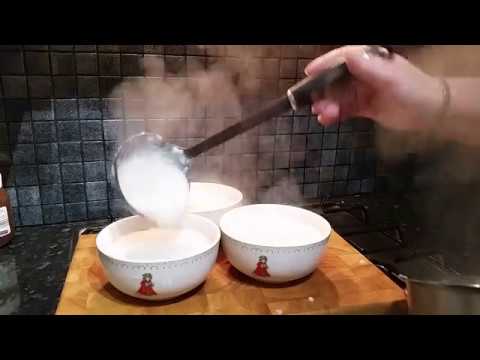
Stir in honey just before serving and transfer to bowls. Optionally dust with ground cinnamon.Adding honey after cooking preserves its aromatic profile and enzymatic integrity.
Recommended Equipment

Nutrition Facts
Servings 2
Serving Size 1 portion
- Amount Per Serving
- Calories 267.61kcal
- % Daily Value *
- Total Fat 16.38g26%
- Saturated Fat 9.94g50%
- Cholesterol 52.44mg18%
- Sodium 119.09mg5%
- Potassium 401.26mg12%
- Total Carbohydrate 23.39g8%
- Dietary Fiber 0.72g3%
- Sugars 22.7g
- Protein 8.63g18%
- Vitamin A 671.42 IU
- Calcium 333.32 mg
- Vitamin D 2.99 mcg
- Vitamin E 0.39 mg
- Vitamin K 1.88 mcg
- Thiamin 0.15 mg
- Riboflavin 0.36 mg
- Niacin 0.31 mg
- Vitamin B6 0.16 mg
- Vitamin B12 1.41 mcg
- Pantothenic Acid 0.99 mg
- Phosphorus 264.14 mg
- Magnesium 32.17 mg
- Zinc 1.12 mg
- Selenium 5.14 mcg
- Manganese 0.25 mg
* Nutrition information is provided as an estimate per serving and may vary depending on the ingredients, brands, substitutions, portion sizes and preparation methods used. Percent Daily Values (%DV) are based on U.S. FDA reference values for a 2,000-calorie diet and are intended as a general guide only. Individual nutritional needs vary. This information is not a substitute for advice from a registered dietitian or other qualified healthcare professional.
Note
Store in an airtight container under refrigeration, ensuring minimal air exposure to preserve flavour integrity and textural balance. The resting phase supports structural stabilisation and moisture redistribution. Cutting or serving too early may compromise internal balance. Dairy-based elements may thicken further upon cooling. Reheat gently to prevent separation or grainy texture. Monitor seasoning levels after storage, as salt perception can shift once chilled.


