
Recipe Snapshot
Recipe at a Glance
Key timing, yield and style details before you start cooking.
Fat and Acid Equilibrium in Coconut-Based Broths
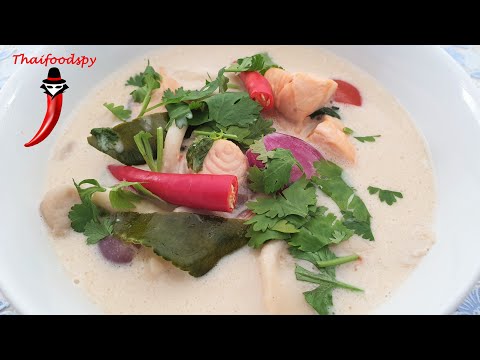
The structural integrity of Tom Kha Pla depends on balancing coconut milk’s saturated fat with controlled acidity from lime juice and lemongrass. Excess acid destabilises the emulsion, causing fat separation, while insufficient acid leaves the broth flat. Galangal provides aromatic sharpness that cuts through the fat phase, maintaining sensory clarity. Fish protein contributes mild gelatin, slightly thickening the liquid when simmered gently. Salt calibration must occur after the fish is cooked to avoid over-seasoning as reduction concentrates salinity. The final broth should present a cohesive, glossy surface without visible oil pooling, indicating correct emulsification and temperature management.
Temperature Staging and Moisture Control
Heat management defines the soup’s clarity and mouthfeel. Coconut milk must never reach a rolling boil; instead, maintain a gentle simmer around 85–90°C to prevent curdling. Fish fillets require submersion in hot but not boiling liquid to cook evenly without breaking apart. Lemongrass and galangal release volatile oils optimally under sustained low heat, while kaffir lime leaves should be added mid-simmer to prevent bitterness. Evaporation must be minimal to preserve volume and maintain the intended fat-to-liquid ratio. Controlled simmering ensures the broth remains opaque yet smooth, with no protein scum or split fat layer.
Transformation Through Simmering and Infusion
During cooking, aromatic compounds migrate from fibrous roots and herbs into the coconut matrix, forming a layered flavour base. Galangal’s phenolic compounds and lemongrass citral dissolve into the fat phase, while fish amino acids enrich the aqueous phase. This dual-phase extraction yields depth without heaviness. The soup’s texture transitions from thin to lightly viscous as proteins denature and emulsified fat stabilises. Proper timing ensures the fish remains tender, not chalky. Over-simmering destroys volatile aromatics and dulls acidity, while under-simmering leaves the broth underdeveloped and structurally weak.
Workflow Efficiency and Sequencing Logic
Mise en place precision prevents over-infusion and textural collapse. Aromatics should be bruised and portioned before heating begins. Coconut milk and stock must be pre-measured to avoid delay once heat is applied. Fish should be cut last to minimise oxidation and moisture loss. Parallel preparation of garnish elements—chilli slices and coriander—reduces idle time during simmering. Straining solids before final seasoning ensures a clean presentation and prevents fibrous residue. Efficient sequencing maintains broth stability and prevents temperature fluctuations that could destabilise the emulsion.
Regional Technique Lineage and Adaptation
Tom Kha Pla originates from central Thailand, evolving from the broader Tom Kha family of coconut soups. The fish variant reflects coastal adaptation, substituting poultry with local freshwater or marine fish. The method retains the core Thai principle of balancing sweet, sour, salty, and fatty elements through controlled infusion rather than prolonged boiling. Modern kitchens often use filleted white fish for consistency, though traditional versions may employ whole fish sections for collagen depth. The dish exemplifies Thai culinary engineering—precision in aromatic layering and temperature discipline rather than complexity of ingredients.
Recipe Education
Learn the Skills Behind This Recipe
Build confidence with cooking skills, techniques, and tools used in this recipe.
How to Sauté Properly
Master fast cooking, pan heat, and ingredient timing for better texture.
Recommended for the saute method used in this recipe.
Simmer vs Boil
Learn when to simmer, when to boil, and how each affects recipe results.
Recommended for the simmer method used in this recipe.
Cookware Guide
Learn which pots and pans work best for frying, sautéing, simmering, and roasting.
Helpful when using saucepan during preparation.
Cups to Grams
Convert cup measurements more accurately to improve recipe consistency.
Helpful when using measuring cups during preparation.
Teaspoons to Grams
Use small-measure conversions more accurately in cooking and baking.
Helpful when using measuring spoons during preparation.
Cooking Basics
Build safer knife preparation, heat control, timing, and everyday kitchen confidence.
Helpful when using chef knife during preparation.


Tom Kha Pla (Fish Coconut Soup)
Description
The structural integrity of Tom Kha Pla depends on balancing coconut milk’s saturated fat with controlled acidity from lime juice and lemongrass. Excess acid destabilises the emulsion, causing fat separation, while insufficient acid leaves the broth flat. Galangal provides aromatic sharpness that cuts through the fat phase, maintaining sensory clarity. Fish protein contributes mild gelatin, slightly thickening the liquid when simmered gently. Salt calibration must occur after the fish is cooked to avoid over-seasoning as reduction concentrates salinity. The final broth should present a cohesive, glossy surface without visible oil pooling, indicating correct emulsification and temperature management.
Ingredients
Ingredients
Instructions
Instructions
Step 1
Combine coconut milk and fish stock in a Saucepan over medium heat. Add lemongrass, galangal, kaffir lime leaves, and shallots. Bring to a gentle simmer and maintain at 85–90°C for 10 minutes to extract aromatics.Avoid boiling; excessive heat separates coconut fat and causes a greasy surface.Step 2
Add fish fillet pieces to the simmering broth. Cook gently for 4–5 minutes until opaque and just firm. Do not stir vigorously to prevent breakage.Use a Silicone Spatula to submerge fish evenly without agitation to maintain structure.Step 3
Stir in fish sauce and palm sugar. Continue simmering for 2 minutes to integrate seasoning. Adjust salt if required.Add fish sauce after protein is set to prevent premature tightening of flesh from salt exposure.Step 4
Remove from heat. Add lime juice and sliced chillies. Stir gently to distribute acidity and heat evenly through the broth.Introduce lime juice off heat to preserve volatile acids and prevent curdling of coconut milk.Step 5
Strain out lemongrass, galangal, and kaffir lime leaves using a Sieve. Ladle soup into bowls and garnish with fresh coriander leaves before serving.Straining ensures a smooth mouthfeel and prevents fibrous residue from disrupting the broth’s texture.
Recommended Equipment

Nutrition Facts
Servings 4
Serving Size 1 portion
- Amount Per Serving
- Calories 310.58kcal
- % Daily Value *
- Total Fat 22.24g35%
- Saturated Fat 18.63g94%
- Cholesterol 37.5mg13%
- Sodium 1592.09mg67%
- Potassium 658.12mg19%
- Total Carbohydrate 11.61g4%
- Dietary Fiber 0.35g2%
- Sugars 2.45g
- Protein 19.6g40%
- Vitamin A 193.41 IU
- Vitamin C 7.33 mg
- Calcium 64.69 mg
- Iron 4.88 mg
- Vitamin D 2.33 mcg
- Vitamin E 0.5 mg
- Vitamin K 9.25 mcg
- Thiamin 0.07 mg
- Riboflavin 0.1 mg
- Niacin 4.99 mg
- Vitamin B6 0.24 mg
- Folate 52.31 mcg
- Vitamin B12 1.31 mcg
- Pantothenic Acid 0.56 mg
- Phosphorus 261.32 mg
- Magnesium 90.38 mg
- Zinc 1.18 mg
- Selenium 32.9 mcg
- Copper 0.36 mg
- Manganese 1.41 mg
* Nutrition information is provided as an estimate per serving and may vary depending on the ingredients, brands, substitutions, portion sizes and preparation methods used. Percent Daily Values (%DV) are based on U.S. FDA reference values for a 2,000-calorie diet and are intended as a general guide only. Individual nutritional needs vary. This information is not a substitute for advice from a registered dietitian or other qualified healthcare professional.
Note
Allow the dish to cool gradually before sealing. Rapid temperature shifts can create condensation, weakening texture and diluting surface flavour concentration. Adequate chilling or marination enhances aromatic absorption and improves cohesion between fat, acid, and seasoning components. Dairy-based elements may thicken further upon cooling. Reheat gently to prevent separation or grainy texture. Slow-cooked preparations often improve after several hours or overnight refrigeration as aromatic compounds integrate more fully. Acid balance may soften slightly over time; a final adjustment before serving restores clarity.


