
Recipe Snapshot
Recipe at a Glance
Key timing, yield and style details before you start cooking.
Aromatic Equilibrium and Acid-Fat Balance
Tom Yum Kung Mae Nam relies on a precise equilibrium between aromatic volatility and acid-fat modulation. Lemongrass, galangal, and kaffir lime leaves provide volatile oils that must be extracted without bitterness. The acid phase, primarily from lime juice, interacts with the shrimp’s natural sweetness and the fat from evaporated milk or coconut milk, forming a balanced emulsion that softens the chili heat. Salt and fish sauce calibrate ionic strength, ensuring the broth’s salinity enhances umami without masking citrus brightness. The sequencing of these ingredients—aromatics first, acids last—prevents curdling and preserves clarity.
Thermal Control and Extraction Management
Temperature staging defines the soup’s success. Aromatics are simmered at sub-boiling temperatures to extract essential oils without volatilizing them prematurely. Once prawns are introduced, heat must be reduced to prevent protein tightening and moisture loss. Overheating leads to rubbery texture and clouded broth. Controlled simmering allows the chili paste to disperse evenly, while maintaining a stable emulsion. Carryover heat continues to cook the prawns after removal from direct flame, so timing must anticipate this residual effect. The final addition of lime juice occurs off heat to preserve acidity and prevent bitterness.
Transformation Through Layered Cooking
The dish transitions from raw aromatics to a complex, layered broth through sequential extraction and emulsification. Galangal and lemongrass release terpenes that form the aromatic base, followed by chili paste integration that deepens color and viscosity. The addition of prawns introduces protein-based sweetness and light gelatin, enriching mouthfeel. Evaporated milk or coconut milk modifies the broth’s refractive density, creating a slightly opaque, cohesive texture. The final lime addition rebalances the palate, cutting through fat and spice to yield a clean finish. Each phase builds structural depth without overcomplicating the broth.
Workflow Efficiency and Mise en Place Logic
Efficient execution depends on disciplined mise en place. Aromatics should be pre-cut and portioned, chili paste measured, and prawns deveined before heat application begins. The broth base can be pre-simmered and held at low temperature while other components are prepared. Parallel processing—such as slicing mushrooms while aromatics infuse—reduces idle time. Maintaining a clean station prevents cross-contamination between raw seafood and finished broth. Final assembly should occur rapidly to preserve volatile aromatics and prevent overcooking. This workflow ensures consistency under service conditions and minimizes sensory degradation.
Regional Technique Lineage and Adaptation
Tom Yum Kung Mae Nam originates from central Thailand, where river prawns were abundant along the Chao Phraya basin. The Mae Nam variant distinguishes itself by using large freshwater prawns and a slightly creamy broth, a modern adaptation influenced by Bangkok’s urban kitchens. Traditional clear versions used no dairy component, but the addition of evaporated milk or coconut milk evolved to temper chili intensity and enhance mouthfeel. The soup’s structure reflects Thai culinary logic—balancing sour, salty, spicy, and aromatic dimensions through controlled sequencing and precise thermal management.
Recipe Education
Learn the Skills Behind This Recipe
Build confidence with cooking skills, techniques, and tools used in this recipe.
How to Boil Properly
Learn boiling times, temperature control, and how to avoid overcooking.
Recommended for the boil method used in this recipe.
How to Sauté Properly
Master fast cooking, pan heat, and ingredient timing for better texture.
Recommended for the saute method used in this recipe.
Cookware Guide
Learn which pots and pans work best for frying, sautéing, simmering, and roasting.
Helpful when using saucepan during preparation.
Cups to Grams
Convert cup measurements more accurately to improve recipe consistency.
Helpful when using measuring cups during preparation.
Teaspoons to Grams
Use small-measure conversions more accurately in cooking and baking.
Helpful when using measuring spoons during preparation.
Simmer vs Boil
Learn when to simmer, when to boil, and how each affects recipe results.
Recommended for the simmer method used in this recipe.


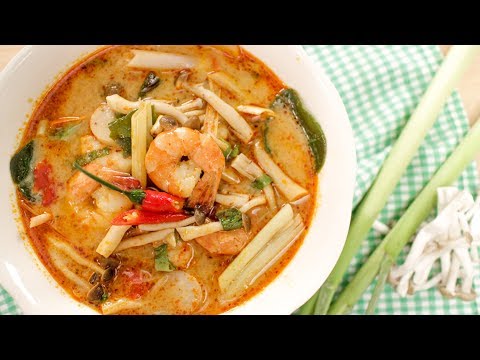
Tom Yum Kung Mae Nam (River Prawn Soup)
Description
Tom Yum Kung Mae Nam relies on a precise equilibrium between aromatic volatility and acid-fat modulation. Lemongrass, galangal, and kaffir lime leaves provide volatile oils that must be extracted without bitterness. The acid phase, primarily from lime juice, interacts with the shrimp’s natural sweetness and the fat from evaporated milk or coconut milk, forming a balanced emulsion that softens the chili heat. Salt and fish sauce calibrate ionic strength, ensuring the broth’s salinity enhances umami without masking citrus brightness. The sequencing of these ingredients—aromatics first, acids last—prevents curdling and preserves clarity.
Ingredients
Ingredients
Instructions
Instructions
Step 1
Prepare all aromatics: bruise lemongrass, slice galangal, and tear kaffir lime leaves. Devein river prawns and halve straw mushrooms.Keep prawns chilled until use to prevent premature protein denaturation.Step 2
In a Saucepan, heat vegetable oil over medium heat. Add Thai chili paste and bloom for 30 seconds until fragrant.Avoid overheating chili paste; excessive heat causes bitterness and oil separation.Step 3
Add water, lemongrass, galangal, and kaffir lime leaves. Simmer gently for 5–7 minutes to extract aromatics.Maintain sub-boiling temperature to preserve volatile citrus oils.Step 4
Add straw mushrooms and bird’s eye chili. Continue simmering for 3 minutes until mushrooms soften.Do not cover the pan; open simmering prevents excessive condensation and dilution.Step 5
Add river prawns and cook for 2–3 minutes until they turn opaque and firm.Remove prawns immediately once color changes to prevent overcooking from carryover heat.Step 6
Reduce heat to low, stir in fish sauce, sugar, and evaporated milk. Mix gently until uniform.Incorporate milk slowly to avoid curdling; maintain below simmering temperature.Step 7
Remove from heat, add lime juice, and stir briefly. Adjust seasoning if necessary.Always add lime juice off heat to preserve acidity and prevent bitterness.Step 8
Ladle soup into bowls and garnish with fresh coriander leaves before serving.Serve immediately to retain aromatic intensity and prevent prawn over-resting.
Recommended Equipment

Nutrition Facts
Servings 2
Serving Size 1 portion
- Amount Per Serving
- Calories 292.55kcal
- % Daily Value *
- Total Fat 10.45g17%
- Saturated Fat 2.71g14%
- Cholesterol 210.52mg71%
- Sodium 1809.09mg76%
- Potassium 740.52mg22%
- Total Carbohydrate 21.85g8%
- Dietary Fiber 1.46g6%
- Sugars 8.52g
- Protein 31.38g63%
- Vitamin A 182.79 IU
- Vitamin C 14.75 mg
- Calcium 201.74 mg
- Iron 3.04 mg
- Vitamin E 0.71 mg
- Vitamin K 14.1 mcg
- Thiamin 0.06 mg
- Riboflavin 0.19 mg
- Niacin 1.2 mg
- Vitamin B6 0.16 mg
- Folate 46.1 mcg
- Vitamin B12 0.14 mcg
- Pantothenic Acid 0.45 mg
- Phosphorus 395.06 mg
- Magnesium 102.88 mg
- Zinc 2.71 mg
- Selenium 10.4 mcg
- Copper 0.7 mg
- Manganese 0.93 mg
* Nutrition information is provided as an estimate per serving and may vary depending on the ingredients, brands, substitutions, portion sizes and preparation methods used. Percent Daily Values (%DV) are based on U.S. FDA reference values for a 2,000-calorie diet and are intended as a general guide only. Individual nutritional needs vary. This information is not a substitute for advice from a registered dietitian or other qualified healthcare professional.
Note
Allow the dish to cool gradually before sealing. Rapid temperature shifts can create condensation, weakening texture and diluting surface flavour concentration. Dairy-based elements may thicken further upon cooling. Reheat gently to prevent separation or grainy texture. Slow-cooked preparations often improve after several hours or overnight refrigeration as aromatic compounds integrate more fully. Monitor seasoning levels after storage, as salt perception can shift once chilled.


