
Recipe Snapshot
Recipe at a Glance
Key timing, yield and style details before you start cooking.
Aromatic Base and Flavour Equilibrium
The structural balance of Tom Yum Tofu relies on the interplay between acid, salt, and umami. Lemongrass, galangal, and kaffir lime leaves provide volatile oils that define the aromatic base, while lime juice and tamarind paste deliver controlled acidity. Soy sauce replaces fish sauce to maintain salinity and depth without animal derivatives. The tofu’s protein matrix absorbs these flavours effectively when simmered briefly, ensuring internal seasoning without textural collapse. Mushrooms contribute glutamates that reinforce savoury perception, while chili paste introduces capsaicin-driven heat balanced by the broth’s acidity. Maintaining this equilibrium prevents the soup from becoming overly sharp or flat.
Thermal Management and Extraction Control
Temperature staging is critical to preserve volatile aromatics while achieving full extraction from fibrous herbs. Lemongrass and galangal require a rolling simmer to release essential oils, but prolonged boiling would degrade lime leaf aroma and cloud the broth. Introducing tofu and mushrooms after initial reduction prevents overcooking and maintains clarity. Carryover heat continues flavour infusion during resting, so final seasoning must account for this residual extraction. Controlled simmering rather than vigorous boiling ensures even diffusion of aromatics and prevents protein curdling from tofu surface dehydration.
Textural Development and Flavour Integration
The transformation phase depends on maintaining broth clarity while achieving depth. Mushrooms soften and release glutamates, tofu absorbs liquid through its porous structure, and the broth thickens slightly through natural reduction. The final addition of lime juice and chili paste off heat stabilises brightness and prevents bitterness from prolonged acid exposure. The soup’s texture should remain light yet cohesive, with suspended aromatics rather than sediment. Proper sequencing of ingredients ensures layered flavour perception—aromatic first, sour second, and heat last—achieved through disciplined timing and controlled simmer duration.
Workflow Efficiency and Mise en Place Logic
Efficient execution requires pre-portioning aromatics and liquids to avoid over-extraction. Lemongrass and galangal should be pre-bruised and measured before heating begins. Tofu cubes must be drained and patted dry to prevent dilution. Parallel preparation of garnish elements—fresh coriander and sliced chili—reduces idle time during simmering. Using a single saucepan for both extraction and finishing minimises transfer loss and maintains temperature stability. This workflow ensures consistent output even under service pressure, where timing precision directly affects aromatic retention.
Regional Technique Lineage and Adaptation
Tom Yum originates from central Thailand, traditionally built on shrimp stock and fish sauce. The vegetarian adaptation retains the same structural logic—acidic, aromatic, and spicy—but substitutes plant-based umami sources such as soy sauce and mushrooms. The technique of layering aromatics before adding protein remains unchanged, reflecting Thai culinary emphasis on balance and freshness. Modern vegetarian kitchens adapt the broth base using kombu or mushroom stock to replicate depth without animal components, maintaining authenticity through method rather than ingredient replication.
Recipe Education
Learn the Skills Behind This Recipe
Build confidence with cooking skills, techniques, and tools used in this recipe.
How to Boil Properly
Learn boiling times, temperature control, and how to avoid overcooking.
Recommended for the boil method used in this recipe.
Simmer vs Boil
Learn when to simmer, when to boil, and how each affects recipe results.
Recommended for the simmer method used in this recipe.
Cookware Guide
Learn which pots and pans work best for frying, sautéing, simmering, and roasting.
Helpful when using saucepan during preparation.
Cups to Grams
Convert cup measurements more accurately to improve recipe consistency.
Helpful when using measuring cups during preparation.
Teaspoons to Grams
Use small-measure conversions more accurately in cooking and baking.
Helpful when using measuring spoons during preparation.
Baking Tools Guide
Understand essential tools for mixing, measuring, and preparing recipes.
Helpful when using mixing bowl during preparation.


Tom Yum Tofu (Vegetarian Hot and Sour Soup)
Description
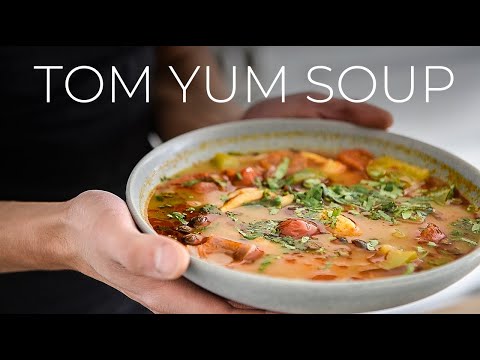
The structural balance of Tom Yum Tofu relies on the interplay between acid, salt, and umami. Lemongrass, galangal, and kaffir lime leaves provide volatile oils that define the aromatic base, while lime juice and tamarind paste deliver controlled acidity. Soy sauce replaces fish sauce to maintain salinity and depth without animal derivatives. The tofu’s protein matrix absorbs these flavours effectively when simmered briefly, ensuring internal seasoning without textural collapse. Mushrooms contribute glutamates that reinforce savoury perception, while chili paste introduces capsaicin-driven heat balanced by the broth’s acidity. Maintaining this equilibrium prevents the soup from becoming overly sharp or flat.
Ingredients
Ingredients
Instructions
Instructions
Step 1
Combine vegetable stock, lemongrass, galangal, and kaffir lime leaves in a Saucepan. Bring to a gentle boil over medium heat, then reduce to a steady simmer for 10 minutes to extract aromatics.Maintain a consistent simmer below boiling to prevent volatile oil loss from lemongrass and galangal.Step 2
Add oyster mushrooms to the simmering broth and cook for 5 minutes until softened and flavour is released into the liquid.Avoid overcrowding the Saucepan; mushrooms need surface exposure for even extraction and texture retention.Step 3
Stir in soy sauce, tamarind paste, salt, and sugar. Continue simmering for 3 minutes to integrate seasoning and balance acidity.Taste the broth before adding tofu; adjust salt or tamarind to achieve a balanced sour-salty base.Step 4
Add tofu cubes carefully and simmer for 3–4 minutes to heat through without breaking structure.Use a Slotted Spoon to submerge tofu gently; agitation can cause surface cracking and cloud the broth.Step 5
Remove from heat. Stir in Thai chili paste and lime juice. Allow to rest for 2 minutes for flavours to stabilise before serving.Adding acid and chili paste off heat preserves brightness and prevents bitterness from prolonged exposure.Step 6
Ladle soup into bowls and garnish with fresh coriander and sliced red chili before serving.Garnish immediately before service to maintain herb freshness and visual clarity of the broth.
Recommended Equipment

Nutrition Facts
Servings 4
Serving Size 1 portion
- Amount Per Serving
- Calories 92.65kcal
- % Daily Value *
- Total Fat 1.94g3%
- Saturated Fat 0.23g2%
- Sodium 1836.35mg77%
- Potassium 256.91mg8%
- Total Carbohydrate 14.95g5%
- Dietary Fiber 1.38g6%
- Sugars 6.08g
- Protein 5.35g11%
- Vitamin A 825.23 IU
- Vitamin C 18.7 mg
- Calcium 61.01 mg
- Iron 1.8 mg
- Vitamin D 0.17 mcg
- Vitamin E 0.16 mg
- Vitamin K 9.49 mcg
- Thiamin 0.07 mg
- Riboflavin 0.13 mg
- Niacin 1.79 mg
- Vitamin B6 0.11 mg
- Folate 21.26 mcg
- Pantothenic Acid 0.39 mg
- Phosphorus 55.81 mg
- Magnesium 18.32 mg
- Zinc 0.43 mg
- Selenium 0.91 mcg
- Copper 0.12 mg
- Manganese 0.48 mg
* Nutrition information is provided as an estimate per serving and may vary depending on the ingredients, brands, substitutions, portion sizes and preparation methods used. Percent Daily Values (%DV) are based on U.S. FDA reference values for a 2,000-calorie diet and are intended as a general guide only. Individual nutritional needs vary. This information is not a substitute for advice from a registered dietitian or other qualified healthcare professional.
Note
Allow the dish to cool gradually before sealing. Rapid temperature shifts can create condensation, weakening texture and diluting surface flavour concentration. The resting phase supports structural stabilisation and moisture redistribution. Cutting or serving too early may compromise internal balance. Slow-cooked preparations often improve after several hours or overnight refrigeration as aromatic compounds integrate more fully. Monitor seasoning levels after storage, as salt perception can shift once chilled.


